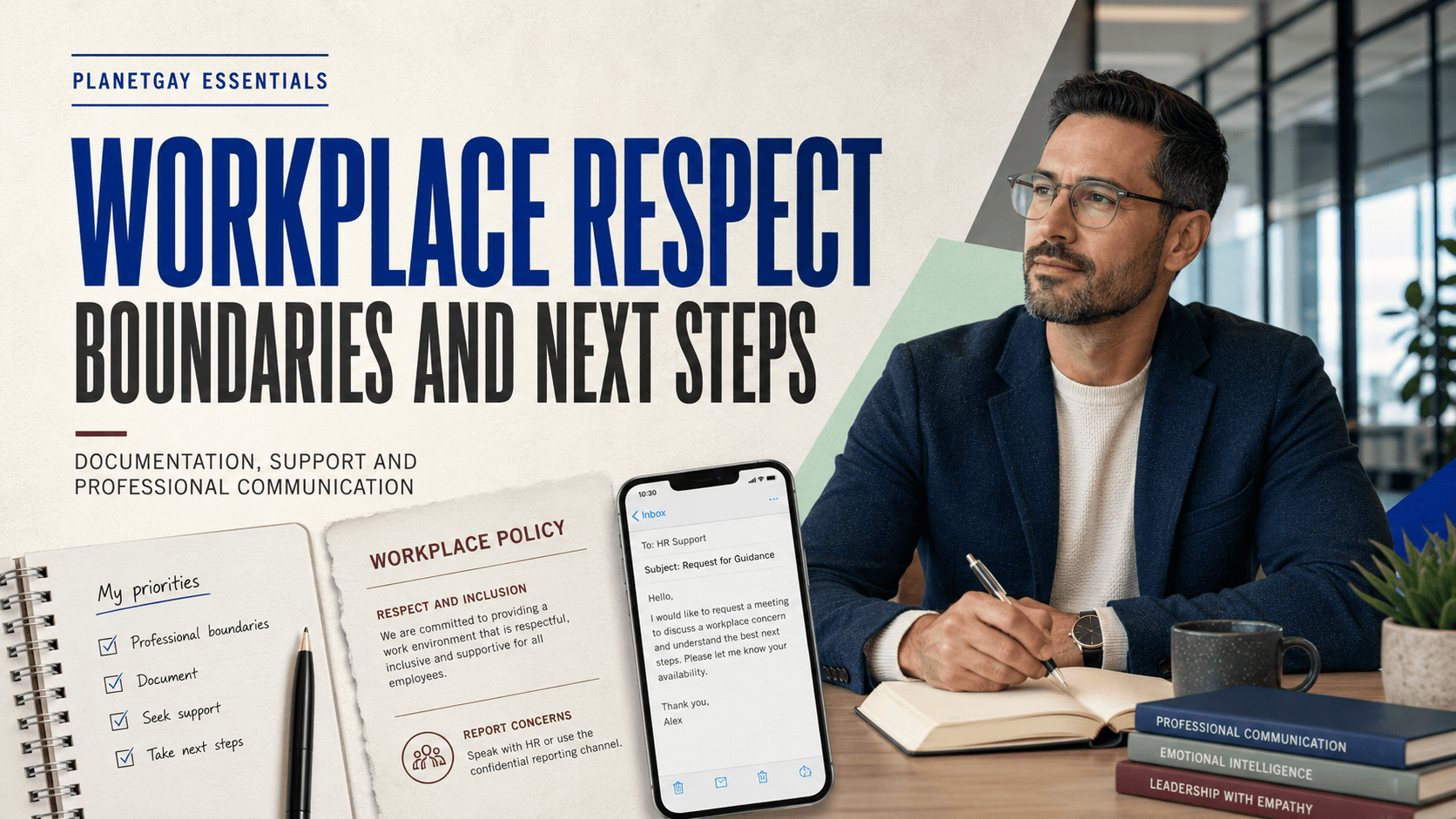
The decision after the decision
The moment of disclosure — telling a manager or colleagues that you are gay — is often what gets discussed. Less discussed is the ongoing reality of being gay at work: the continuous small decisions about what to share, how to handle questions, where to draw privacy lines, and how to navigate a professional environment that was not designed with you specifically in mind.
This article is for men who have already made some decisions about disclosure at work, or who are navigating everyday workplace life as a gay man regardless of how out they are. It is not a coming-out guide — that is covered elsewhere on this site. It is about what happens after.
Privacy is not the same as hiding
A common tension for gay men in workplaces is between the desire for privacy — the sense that your sexuality is your own business and not something you owe colleagues — and the social pressure to participate in the kind of reciprocal personal disclosure that colleagues engage in routinely. Conversations about weekends, partners, holidays and family are the fabric of ordinary workplace social interaction. For a gay man, these conversations involve an ongoing implicit decision about how much to share.
Having boundaries around personal information at work is legitimate and does not require justification. Not every colleague needs to know the details of your personal life, your relationship status or who you spend your time with. This is true for straight colleagues too — some people are private and some are open, and both are normal positions.
What is worth distinguishing is the difference between privacy as a considered preference and avoidance as a response to fear. If you are deflecting questions about your personal life primarily because you are afraid of how colleagues will respond, that is a different situation from simply preferring professional relationships that are not highly personal. The first is something worth attending to; the second is a legitimate personal style.
Handling the questions that come up
In most workplaces, if colleagues know you are gay, questions about your relationship, your partner or your social life will arise. Some of these questions are entirely well-intentioned and some are intrusive; most are somewhere in between — normal social curiosity applied to a context the questioner hasn't quite thought through.
Some practical approaches:
**The redirect:** 'I'll keep that between me and my partner' or 'I keep work and personal life fairly separate' — both of these set a limit politely without making the question itself a problem.
**The matter-of-fact answer:** For men who are comfortable and in an environment that seems safe, simply answering the question as if it is as ordinary as it would be for a straight colleague (because it is) tends to be effective. 'My partner and I went to…' said without commentary or precaution normalises the relationship without performance.
**The correction:** If a colleague assumes you have a girlfriend based on a reference to 'a partner', correcting the assumption — 'actually my partner is a man' — is simple and often reduces future awkwardness more than letting the assumption persist.
None of these approaches is right for every situation. The choice depends on your own comfort, the workplace culture and the relationship with the specific colleague.
Workplace culture and how to read it
Not every workplace is equally welcoming, and the degree to which being openly gay at work is comfortable depends significantly on the specific workplace culture rather than just the general legal context. A workplace with formal LGBTQ+ equality policies, visible LGBTQ+ employees and active inclusion programmes provides a different environment from a workplace where LGBTQ+ issues are never mentioned, there are no visible LGBTQ+ colleagues, and the dominant culture is traditionally masculine.
Reading the workplace culture before making significant disclosure decisions is practical, not paranoid. Things that provide useful signals: whether the organisation has public LGBTQ+ inclusion commitments; whether LGBTQ+ colleagues are visible and out; how management has handled other sensitive personal disclosures; whether casual homophobic language is tolerated or challenged.
Stonewall's Workplace Equality Index ranks UK employers on LGBTQ+ inclusion and is a useful signal if you are considering employment at a specific organisation. Similar indices exist in other countries for major employers.
Legal protections and when to use them
In most countries with marriage equality, sexual orientation is a protected characteristic in employment. This means dismissal, harassment, failure to promote or other adverse treatment because you are gay is illegal. In the UK, the Equality Act 2010 protects against discrimination and harassment on the basis of sexual orientation. In Canada, the Canadian Human Rights Act and provincial codes provide equivalent protection. Similar protections exist across the EU, Australia, New Zealand and much of the English-speaking world.
Knowing these protections exist is useful background. Using them involves a formal process — usually an internal grievance first, then an employment tribunal or equivalent — that is often stressful and slow. For situations that are merely uncomfortable rather than clearly discriminatory, formal processes may not be the right first step. For situations involving clear discrimination or harassment, documenting incidents and seeking advice from a union, an HR department or a legal advisor is the appropriate response.
Stonewall (stonewall.org.uk/resources) maintains workplace guidance relevant to UK employees. Your national LGBTQ+ advocacy organisation can direct you to relevant employment rights guidance.
Managing visibility at different career stages
Visibility at work tends to change over time as you move through different career stages, different employers and different contexts. A gay man who was very private in his first job in a conservative industry may become more open as he moves to a more accepting environment or a senior position where he has more control over his context.
There is no obligation to be consistent across contexts or over time. Being out in one job and not in the next, or being out to some colleagues and not others, is a normal pattern of navigating contexts rather than a form of dishonesty. Each decision is yours, based on your own assessment of the environment and what you need.
For gay men in leadership positions, visibility carries a specific dimension: being openly gay in a senior role models that it is possible to be gay and successful in that organisation or field. Some gay men in senior positions choose to be actively visible as a form of support for junior colleagues; others maintain privacy at the same level as straight senior colleagues. Both are legitimate positions.