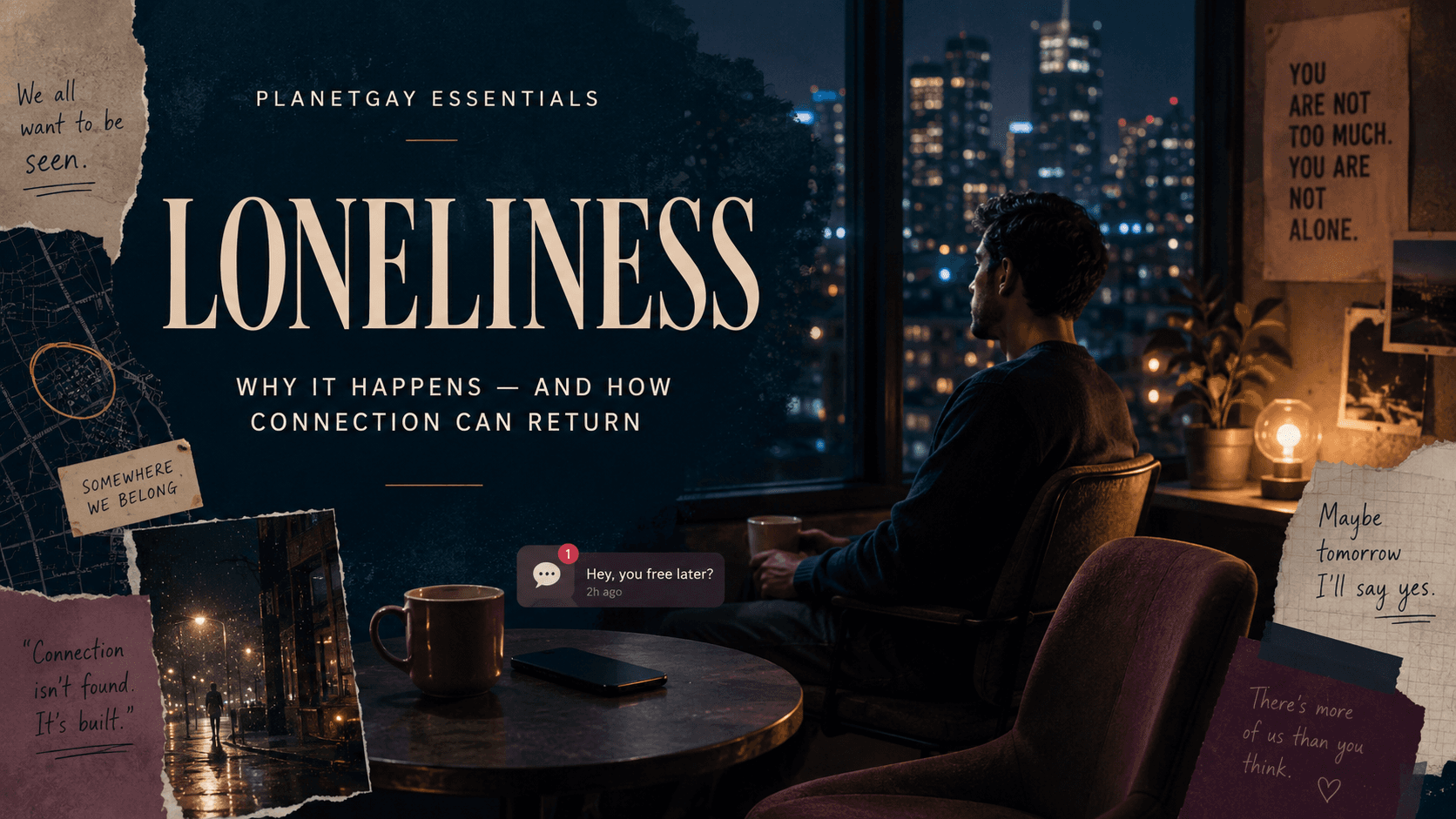
What internalized homophobia actually is
Internalized homophobia refers to negative feelings, beliefs or attitudes about homosexuality and bisexuality that a gay or bisexual person has absorbed from the surrounding culture — family, religion, media, school, law — and applied to themselves. It is not unique to gay men and it is not a disorder. It is the predictable result of growing up in environments that communicate, in many ways and at many levels, that same-sex attraction is wrong, shameful or inferior.
Research in psychology, including the APA Guidelines for Psychological Practice with Sexual Minority Persons, acknowledges internalized stigma as a significant factor affecting the mental health and wellbeing of LGBTQ+ people. Naming it as such — as an external message absorbed rather than an internal truth — is the starting point for working with it.
How it shows up
Internalized homophobia can appear in forms that are recognisable and in forms that are subtle. More visible forms: shame about being attracted to men; disgust at your own sexuality; active avoidance of anything that feels gay; discomfort around openly gay people; trying to suppress or change your attraction.
Subtler forms: a tendency to distance yourself from gay men you judge as 'too gay'; putting other gay men down for expressing their identity in ways you find threatening; pursuing relationships that are partly motivated by a wish to prove you are normal; feeling that your romantic and sexual life has to remain hidden because it is somehow lesser; treating your sexuality as a private embarrassment rather than an ordinary part of who you are.
Both forms create costs — in relationships, in self-respect, in the kind of authentic life you are able to live.
Where it comes from
The sources of internalized homophobia are usually external and social. They include: families where homosexuality was explicitly or implicitly disapproved of; religious traditions that frame same-sex attraction as sinful, disordered or requiring suppression; educational environments where gay was used as an insult and no positive models of LGBTQ+ life were present; media that historically presented gay people as victims, villains or jokes; laws that criminalised same-sex activity; and the overall social experience of growing up in a world that, until recently, was structured around the assumption of heterosexuality.
Recognising that these messages came from outside you — that they were absorbed from your environment, not discovered as truths about yourself — does not make them disappear, but it changes the relationship you can have with them.
The relationship between internalized homophobia and mental health
Research in LGBTQ+ mental health consistently finds that internalized stigma is associated with higher rates of depression, anxiety, substance use and difficulties in relationships. Mind, the UK mental health organisation, describes the experience of minority stress — including the stress of managing an identity that is devalued by the surrounding culture — as a significant factor in LGBTQ+ mental health outcomes.
This does not mean that every gay or bisexual man with depression has internalized homophobia, or that internalized homophobia is the only factor in those statistics. Mental health is complex. But the connection is real and worth taking seriously. If shame about your sexuality is a persistent feature of your internal experience, it is worth treating as a mental health concern, not just as a moral or identity question.
Working through it
Internalized homophobia is not resolved by willpower or by an intellectual decision to feel differently. It tends to change gradually through a combination of exposure — spending time with gay and bisexual people living dignified, ordinary lives; accessing positive cultural representations; building connections where your sexuality is unremarkable rather than shameful — and through working directly with the thoughts and feelings in question.
Therapy with a therapist who has experience with LGBTQ+ clients and who affirms same-sex attraction as normal can be valuable here. This is different from general therapy: working through shame about sexuality requires a therapist who does not bring their own discomfort to the topic. Peer support — groups of gay men talking honestly about shared experience — can be an important adjunct or alternative.
Progress is usually gradual and not linear. Shame about one part of your identity may ease while another remains difficult. That is normal. The goal is not perfection but movement toward a more honest and self-accepting internal life.
When to seek professional support
Professional support is worth seeking if: the shame about your sexuality is affecting your daily functioning, your relationships, or your ability to work; if it is connected to significant depression or anxiety; if it is connected to thoughts of self-harm or suicide; or if you have been managing it alone for a long time without it becoming less heavy.
Some LGBTQ+ mental health organisations also provide specific support. In the UK, Mind has LGBTQ+ mental health resources; the LGBT Foundation provides counselling and peer support. The Trevor Project in the US provides crisis support specifically for LGBTQ+ young people, including a crisis line (1-866-488-7386) and text service (text START to 678678).
If you are in crisis, contact a crisis line or emergency services. Do not wait for the shame to resolve before asking for help.