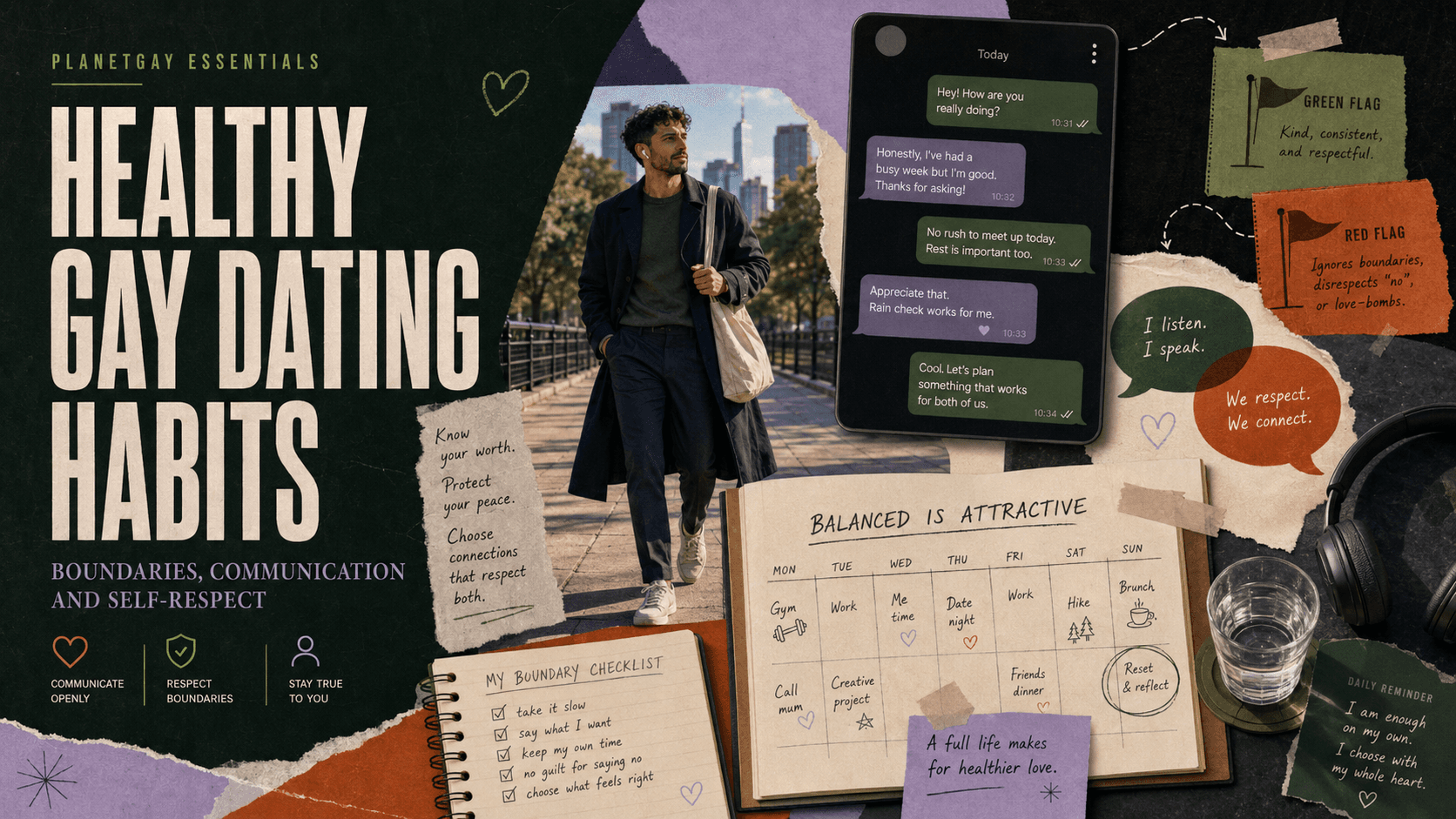
What makes a dating habit healthy or not
A healthy dating habit is one that serves you over time — that brings you closer to the kind of connection you actually want without consistently costing you more than it gives. Unhealthy habits often look fine in isolation but create patterns that exhaust you, lower your self-respect, or put you in the same frustrating situations repeatedly.
For gay and bisexual men, dating can carry specific pressures: the weight of a smaller visible dating pool, the variable norms around what dating means versus what hooking up means, the influence of apps that prioritise immediacy over compatibility, and sometimes the residual effects of internalised shame that make it harder to feel you deserve to be clear about what you want. None of this is inevitable, but it is worth naming because it affects the habits that are easiest and hardest to form.
Know what you are actually looking for
Dating without knowing what you want produces inconsistent decisions and often disappointment — not because you are doing something wrong, but because you are optimising for the wrong thing in the moment.
This does not require absolute certainty. But it helps to have an honest answer to: Am I looking for something casual, something that could become serious, or am I genuinely unsure? These are all valid starting positions, but they have different implications for how you present yourself and what you communicate. Being unclear with yourself leads to being unclear with others, which leads to mismatched expectations and eventual frustration on both sides.
Also worth asking: What has consistently not worked for me, and why? Most people have dating patterns — types they are drawn to, dynamics they recreate — some of which serve them and some of which don't. Identifying those patterns is more useful than resolving to 'do better' without specifics.
Communicate clearly without over-explaining
Clear communication in dating means saying what you mean without excessive qualification, apology or hedging. This is harder than it sounds, particularly if you grew up in an environment where being direct was risky or where you were taught that your wants were somehow unreasonable.
Practical applications:
**State your intentions early enough to matter.** If you are looking for something serious, you do not need to announce this on the first message, but you should be clear before either of you is significantly invested. Waiting indefinitely to reveal your intentions is not kind — it is self-protective at the other person's expense.
**Decline without over-explaining.** If you are not interested in continuing with someone, a brief, honest response is better than either ghosting or a lengthy justification. 'I don't think we're a good match, but I wish you well' is complete. You do not owe detailed feedback.
**Say yes when you mean yes.** If you are interested, be interested. Performing ambivalence to seem less vulnerable is a habit that creates exactly the uncertainty it claims to hedge against.
Setting boundaries without guilt
A boundary in dating is simply a limit on what you are willing to do, accept or continue with. The word has been over-used to the point of meaning almost anything, but the practical version is straightforward: if something is consistently making you feel worse, you can name it and change it.
Common places where boundaries matter:
**Time and contact.** If someone expects rapid responses at all hours and that bothers you, that is worth addressing early. You can reply at your own pace without making it a negotiation, but if the expectation continues and causes friction, naming it directly is better than quietly resenting it.
**Physical pace.** If a date is moving faster physically than you want, saying so is always reasonable. A response that tries to override that tells you something important about the person.
**What you share and when.** You are not required to disclose personal history, health information or family background on any particular timeline. Share what you choose to share when you choose to share it.
Boundaries work best when they are stated matter-of-factly rather than as confrontations. 'I need more time before that' is not an argument — it is information.
Managing the emotional costs of dating
Dating involves consistent low-level uncertainty and occasional rejection, and that takes a real toll if you are not managing it actively. The two most common failure modes are: treating dating as something to endure (going through the motions without genuine engagement) or treating it as something that has total power over your emotional state.
Some things that help:
**Limit your active conversations.** Being in constant contact with six people at once is exhausting and often produces shallower engagement with each of them. Fewer, more genuine interactions tend to work better than treating the app as a revolving door.
**Do not derive your self-worth from outcomes.** Being rejected, stood up or unmatched says very little about you and quite a lot about fit, timing and circumstance. This is easy to say and hard to feel, but noticing when you are personalising impersonal outcomes is the first step.
**Know when to take a break.** If you are consistently approaching dates in a state of anxiety, boredom or cynicism, that is a signal that you need a pause rather than more effort. Taking two weeks off from dating is not a failure.
Self-respect as a consistent practice
Self-respect in dating shows up in small, repeated choices: whether you pursue connections with people who consistently undervalue your time, whether you accept treatment you would advise a friend against, whether you keep investing in situations where the signals are clearly pointing toward a dead end.
The most common pattern worth breaking is staying too long in situations with weak or confusing signals. If you are three weeks in and you still do not know whether this person sees you as a serious possibility, asking is better than hoping. If the answer is unclear, that is itself a clear answer about where you stand.
Self-respect also means being honest about your own behaviour. Are you communicating clearly? Are you treating the people you date with the same consideration you want for yourself? Healthy habits run both ways.