Identity after recognition
Coming to terms with being gay is one process. What comes after — understanding what that identity means in practice — is another, and it often gets less attention. Once the initial recognition settles, many gay men find themselves navigating questions that are less about orientation and more about culture, community, belonging and individuality: What does being gay mean for how I live? Do I have to be interested in the things gay culture is associated with? Do I have to take on any particular political stance? What do I do with labels I was given or gave myself?
This article is not for men who are questioning whether they are gay — that is a separate and earlier question. It is for men who know, or mostly know, and are working out what that means for the shape of their life.
What a label does and does not do
The word 'gay' does useful work. It is a shorthand that communicates something real about attraction and, often, about community membership. Using it publicly — when and if you choose to — gives other people important information about you. Inside LGBTQ+ communities, it can be a point of recognition and solidarity.
But a label is not a complete description of a person. It says something about attraction; it says nothing about personality, interests, politics, values, relationship style, or what you care about. The trap that many gay men fall into early on is feeling that the label comes with a predetermined set of characteristics — that being gay means you must like certain things, talk in a certain way, hold certain cultural references or occupy a certain kind of social space.
None of this is true. The word covers an enormous range of actual human beings. You can be gay and be quietly domestic or intensely social, conservative or radical, interested in gay culture or entirely indifferent to it, visible in one context and private in another. The label is one true thing about you; it is not the only thing.
Gay culture: engaging on your own terms
There is a gay culture — or more precisely, a range of gay cultures that have developed in different cities, countries and historical moments. Pride events, specific music, specific humour, specific social spaces, particular aesthetic styles and references that function as recognition signals all form part of this. For many gay men, entering this culture is a source of genuine joy, belonging and identity. For others, parts of it feel alien, performative or exclusionary.
Both responses are valid. You are not obligated to participate in any specific cultural expression of being gay in order to be authentically gay. Equally, you are not required to reject it to prove you are not a stereotype.
The more useful frame is: what of this culture actually speaks to you? Some of it might. Some of it might feel like belonging. Some of it might not interest you at all, and that is fine too. Identity is not about ticking cultural boxes.
Individuality inside community
One of the more complex tensions of gay identity is between community and individuality. LGBTQ+ community often functions as protective, joyful and affirming — particularly for men who grew up without it. But community also exerts its own social pressures, hierarchies and conformity expectations. Being different within the community — in class, race, disability, body type, interests, politics or relationship style — can produce its own form of exclusion.
This is worth naming because it surprises some men: coming out and entering LGBTQ+ spaces does not automatically solve belonging. You may find aspects of those spaces welcoming and others uncomfortable. That is normal. The gay community is not one thing any more than the label is.
Finding your actual people — the specific human beings with whom there is genuine connection — is more valuable than membership in any abstract community category, and it often takes time.
Identity as something that continues to develop
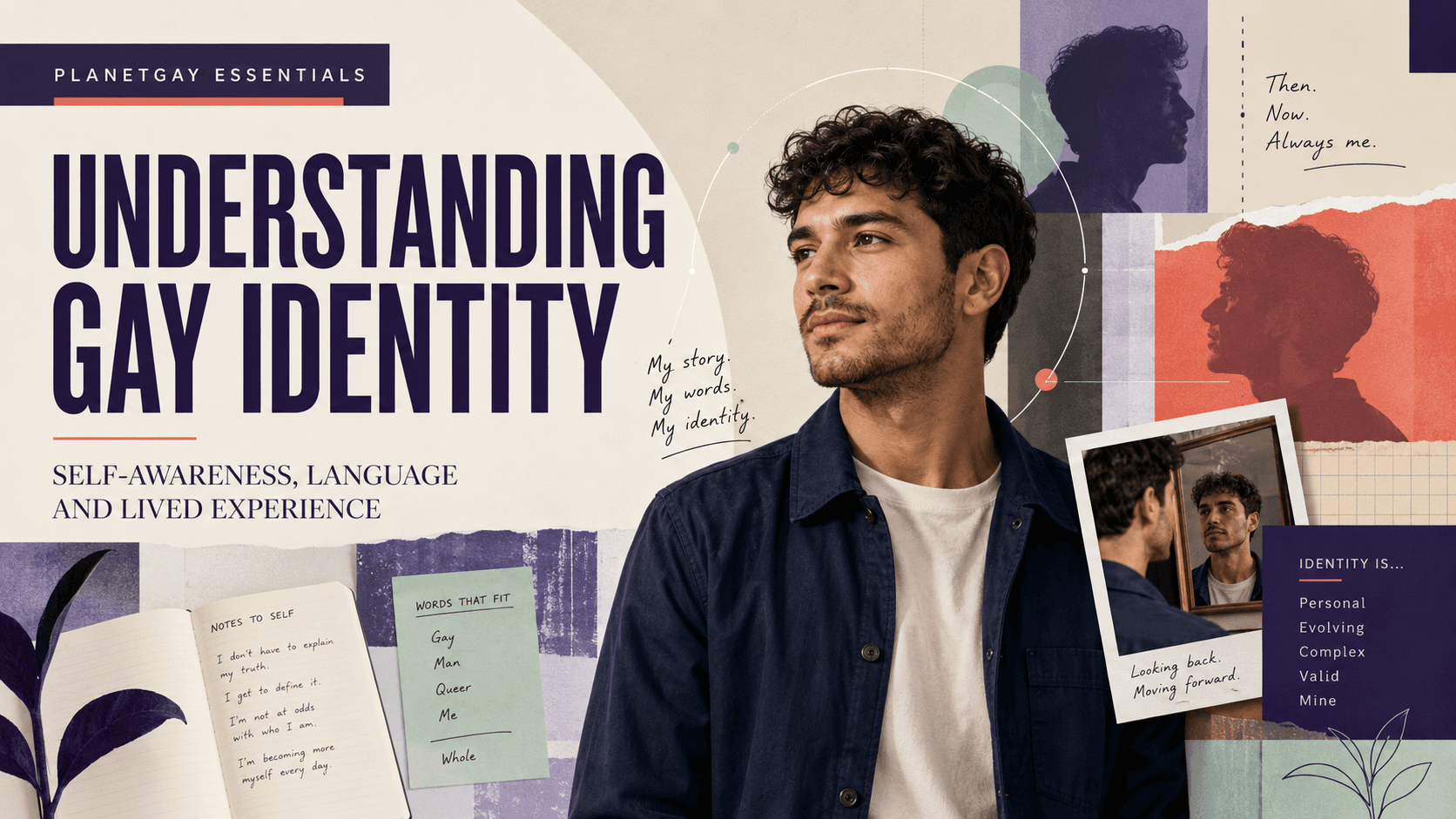
Gay identity is not a fixed destination. How you understand and express your sexuality, your relationship to community and culture, and the way you use (or don't use) labels is likely to change across your life. Men who come out young often look back at their twenties with a very different sense of identity than they had at the time. Men who come out later bring a different life history that shapes what the identity means for them.
The only constant is that there is no external standard you need to meet. You do not need to be gay in the right way, in the expected way, or in the way that any specific community or partner expects of you. The identity is yours to understand and live on your own terms.