What self-acceptance actually means
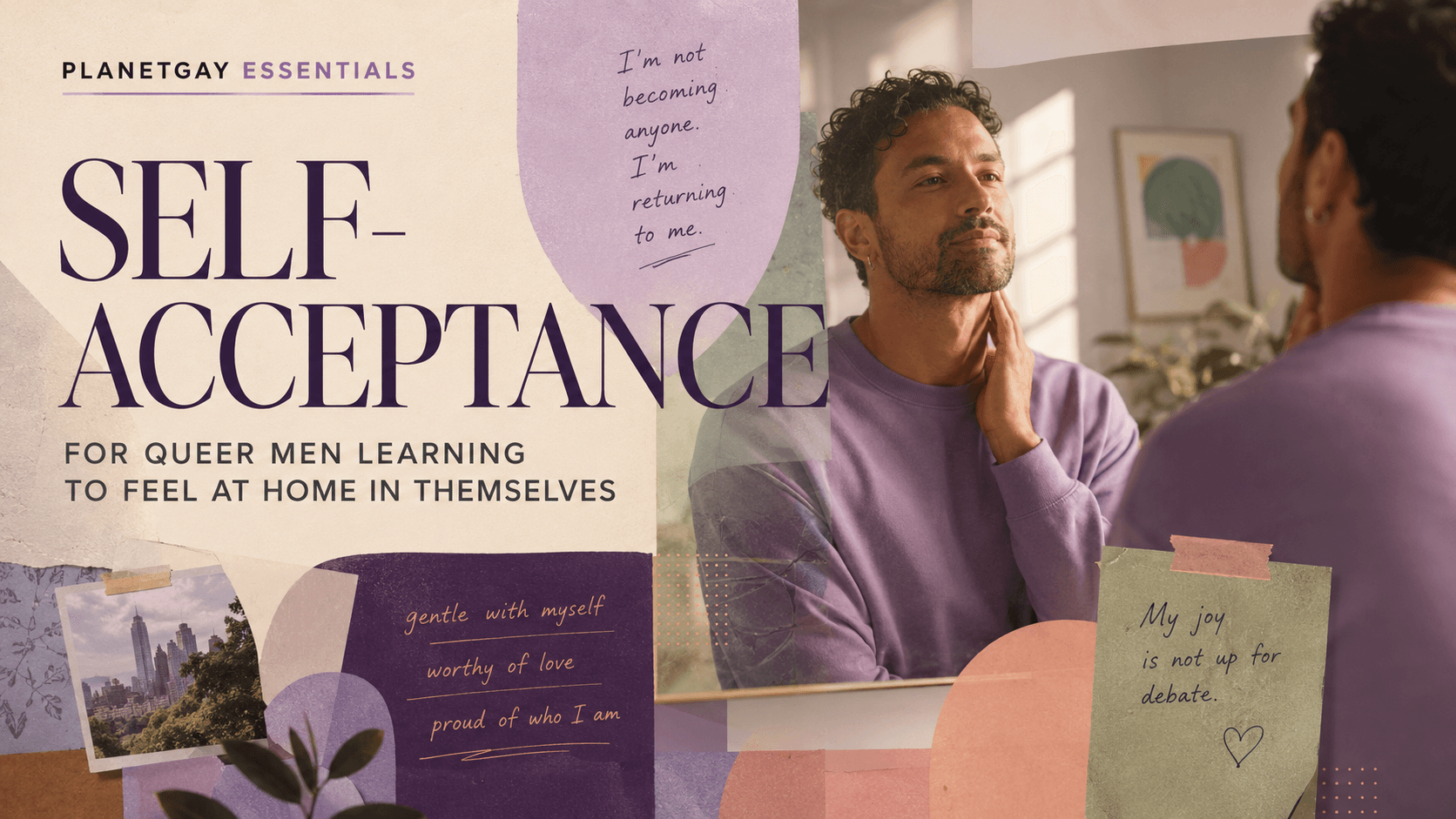
Self-acceptance is not the same as being happy about everything you are, feeling confident at all times, or having no doubts. It is the ability to acknowledge your experience — including the difficult parts — without sustained self-condemnation. For queer men, it specifically involves accepting your sexuality, your desires and your identity without treating them as problems to overcome or flaws to hide.
The reason this is harder for queer men than it sounds is straightforward: most of us grew up surrounded by negative messages about same-sex attraction, whether explicit or ambient. Those messages become internal, and internalised shame is not undone simply by accepting a label. The outward process of coming out and the inward process of self-acceptance happen on different timelines — and the inward process often takes longer.
Where shame comes from
Shame is a learned response. It comes from environments — family, school, religion, media — that conveyed, directly or indirectly, that same-sex attraction is wrong, shameful, lesser, or a problem. When you grow up hearing this, you internalise it long before you have the capacity to question it.
Internalised shame in queer men shows up in patterns that are worth recognising:
**Minimising.** Treating your sexuality as a small part of yourself that doesn't need to take up much space, rather than an aspect of your life that deserves the same room as anything else.
**Over-explaining.** Feeling compelled to justify your identity to others, or to preemptively apologise for who you are.
**Self-policing.** Noticing how you sit, speak, look or dress in order to avoid the perception of being queer — long after it would be safe to stop.
**Perfectionism as armour.** Compensating for feeling fundamentally 'wrong' by being excellent at everything else — work, appearance, social performance.
Identifying the specific forms your internalised shame takes is useful, because you can only address what you can name.
Working with shame rather than against it
The instinct is to fight shame — to argue against it, to try to override it with positive thinking, to push it away. This often doesn't work well, because suppressed shame tends to intensify.
A more sustainable approach is noticing shame without immediately reacting to it. When you notice the voice that says you are wrong, lesser, or too much, you can acknowledge that the voice exists without agreeing with it. This is different from positive self-talk (which often feels hollow) because it doesn't demand that you feel good — only that you don't act on the shame-based narrative.
Over time, bringing the shame into awareness reduces its power. Many men find therapy useful for this — not because a therapist will tell you what to think about yourself, but because a skilled LGBTQ+-affirming therapist can help you trace where specific shame responses come from and build a different relationship with them. This is distinct from general self-improvement: it is specific reparative work for internalised messages that were never accurate to begin with.
Authenticity in practice
Self-acceptance becomes real not in moments of private resolution but in the patterns of actual choices over time. Do you allow yourself to mention a partner in conversation without engineering a way to avoid the pronoun? Do you pursue connections and relationships without a constant side-monitor asking whether you deserve them? Do you let yourself occupy the same amount of emotional and social space that other people occupy without qualification?
Authenticity is not about being maximally visible or taking every opportunity to signal your identity. It is about not systematically diminishing yourself — not modifying your posture, your references, your expressed desires and your social presence to manage others' potential discomfort with who you are. The amount and context of visibility is yours to choose. The habit of self-minimisation is what authenticity works against.
Community as a tool, not a requirement
For many queer men, connection with other LGBTQ+ people accelerates self-acceptance. Seeing gay men living full, ordinary, varied lives — not as cautionary tales, not as stereotypes, not as exceptional cases — is powerful evidence that changes what feels possible. Community also provides context: you can locate your experience within a shared history, rather than treating your life as an anomaly.
But community is not always immediately accessible, not always safe in all contexts, and not always what it promises. Some men find aspects of LGBTQ+ spaces unwelcoming — because of class, race, body, age, disability, interests or values. If that is your experience, it does not mean community is not for you; it means the first community you encountered was not the right fit, and others may be.
Meaningful connection with even a few people who accept you fully — whether gay or not — is more useful for self-acceptance than nominal membership in a larger community that doesn't actually feel affirming.
Self-acceptance as a long-term practice
Self-acceptance does not arrive fully formed and stay permanently. It is more like a practice — something you tend to over time, that can be disrupted by specific experiences (rejection, a hostile environment, a period of isolation) and rebuilt. Men who describe themselves as having good self-acceptance are not people who never feel doubt or shame; they are people who have built enough of a foundation that those feelings do not run the show.
Some things that sustain it over time: continued, deliberate exposure to queer experience and culture that reflects who you actually are; honest relationships where you are not managing other people's comfort at your own expense; regular enough contact with your own feelings that shame doesn't accumulate in silence; and — when the internal noise becomes too much — professional support without shame about needing it.
The work is not about achieving a final state. It is about building a relationship with yourself that can hold difficulty without collapsing into self-condemnation.