Bisexuality as a complete identity
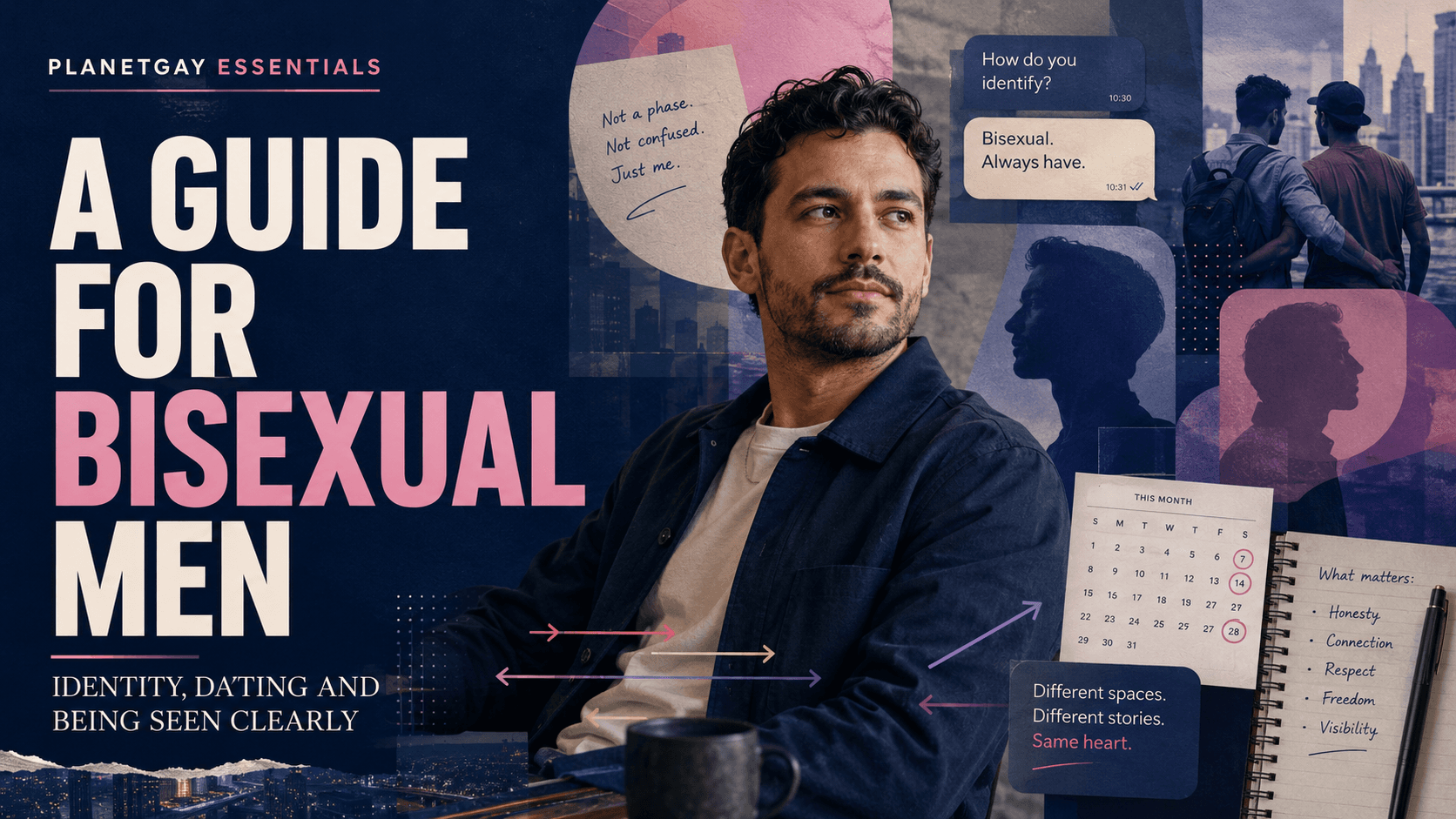
Bisexuality is a stable sexual orientation characterised by attraction — of varying kinds, degrees and frequency — to more than one gender. It is not a transitional state, not confusion about orientation, not an inability to decide, and not the result of insufficient exposure to either gay or straight life. Bisexual men are not secretly gay, not fundamentally straight, and not 'going through a phase.'
This is worth stating plainly because bisexual men encounter these assumptions persistently: from family, from straight peers, from gay communities, from partners, and sometimes from within themselves as a result of internalised biphobia — the specific self-doubt that comes from being surrounded by people who do not believe your identity is real. Knowing the reality is one tool against that pressure.
Bi erasure and where it comes from
Bi erasure is the persistent tendency to explain away or deny bisexual identity. It appears in a few consistent patterns:
**'You're really gay.'** The assumption that a man attracted to both men and women is actually gay and either hasn't fully accepted it or is managing the social costs of being out. This is particularly common when a bisexual man is in a relationship with a man.
**'You're really straight.'** The assumption that a man attracted to both is fundamentally straight and is experimenting, or is gay-adjacent for social reasons. More common when a bisexual man is in a relationship with a woman.
**'It's not real unless...'** Various qualifying demands: unless you've had equal numbers of partners from each gender, unless you feel attraction equally all the time, unless you've been in a certain type of relationship. None of these reflect how sexuality actually works.
Bi erasure comes from both heterosexual and gay communities and is worth naming because it is a real experience, not a perception. It has documented mental-health consequences for bisexual people, who report higher rates of anxiety and depression than both straight and gay populations in research studies — in part because they face discrimination from multiple directions while having less community support than gay men.
Dating as a bisexual man
Dating as a bisexual man involves navigating a wider range of assumptions from potential partners.
From women: the most common concern is that a bisexual male partner will 'end up' with a man, or will cheat with men in ways that feel categorically different. These concerns are worth taking seriously in a conversation, but they are not accurate predictions of behaviour — relationship fidelity and partner choice are not determined by orientation. Some women are not comfortable dating bisexual men; that is their choice, and you cannot change another person's willingness. You can decide whether to disclose and when.
From men: bisexual men sometimes face assumptions about promiscuity (unfounded), disease risk (orientation alone does not determine health practices), or a hierarchy that places them below 'fully gay' men. These are biphobic assumptions worth identifying as such.
You do not owe any partner a detailed history of past relationships by gender, and you do not need to prove your identity through the ratio of who you have dated. Your identity is valid on its own terms.
Bisexuality within relationships
Being bisexual does not disappear when you are in a committed relationship. This is sometimes called 'bisexual erasure by relationship' — the assumption that once a bisexual man is partnered, his identity resolves into whatever his partner's gender implies. This is not how identity works.
Being in a monogamous relationship with a man does not make you gay. Being in a monogamous relationship with a woman does not make you straight. You retain your actual identity and your actual experience of attraction regardless of your partner's gender.
For couples: the bisexual partner's identity is not a threat to the relationship, and the non-bisexual partner's possible insecurity about it is worth addressing directly rather than pretending it does not exist. Many relationships navigate this well; the key is honest communication about what both people need, rather than the bisexual partner being required to minimise or apologise for their identity.
Finding community and support
Bisexual men often have a harder time finding community than gay men, for practical reasons: there is no bisexual equivalent of most gay social infrastructure — bars, apps, social groups — because bisexual identity is generally less visible. Within LGBTQ+ spaces, bi-specific groups and organisations exist in many cities and are worth seeking out.
Online communities dedicated to bisexual identity — forums, subreddits, social media groups — can be useful for connection, particularly for men in areas where bi-specific in-person community is thin. GLAAD, Stonewall and Bi.org maintain resources and lists of bi-specific organisations in various countries.
Therapy can be useful if you are working through bi erasure-related anxiety or internalised biphobia. Look for a therapist who is LGBTQ+ affirming and ideally has experience with bisexual-specific issues rather than just gay and lesbian concerns — the experiences are related but distinct.