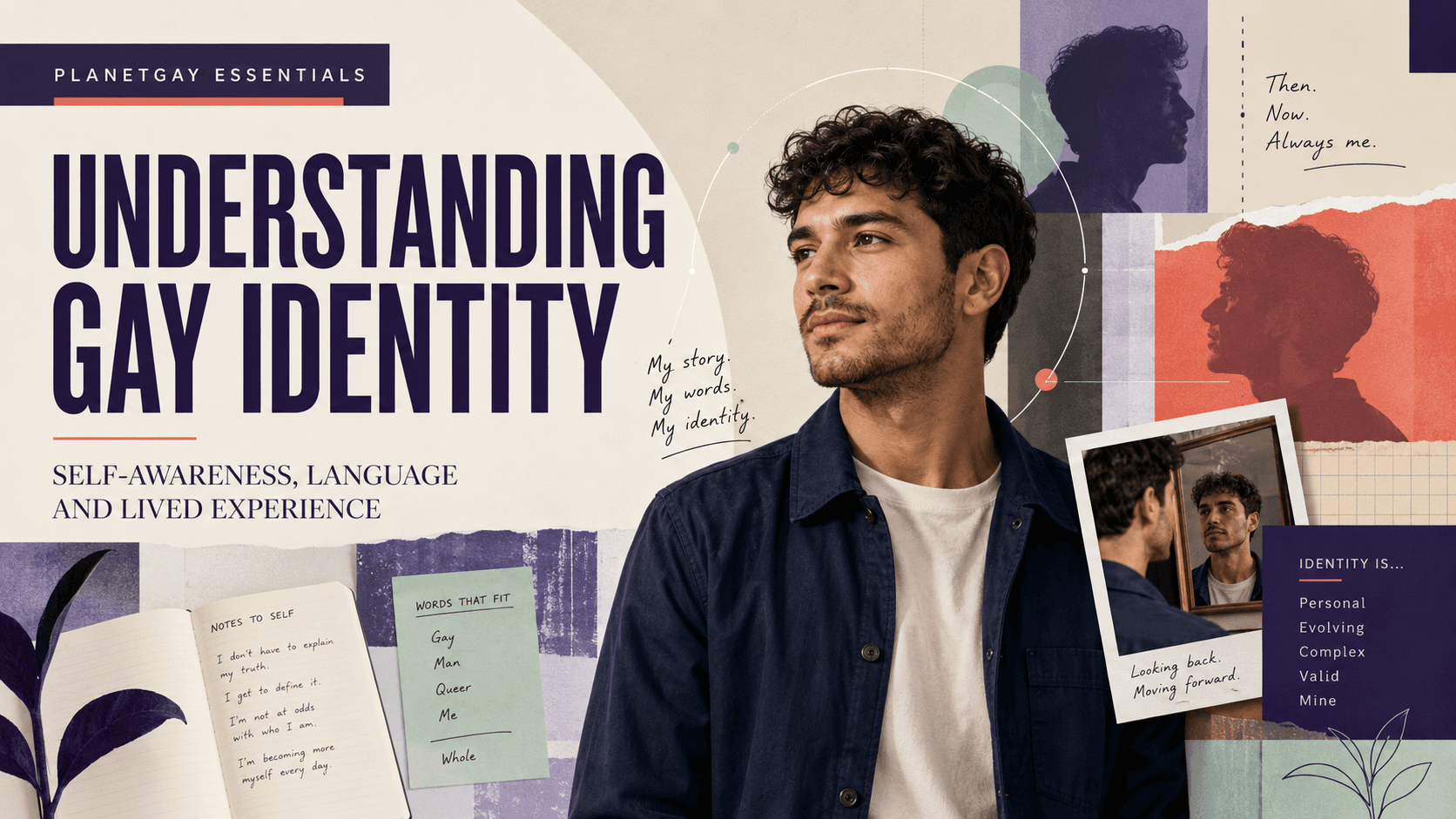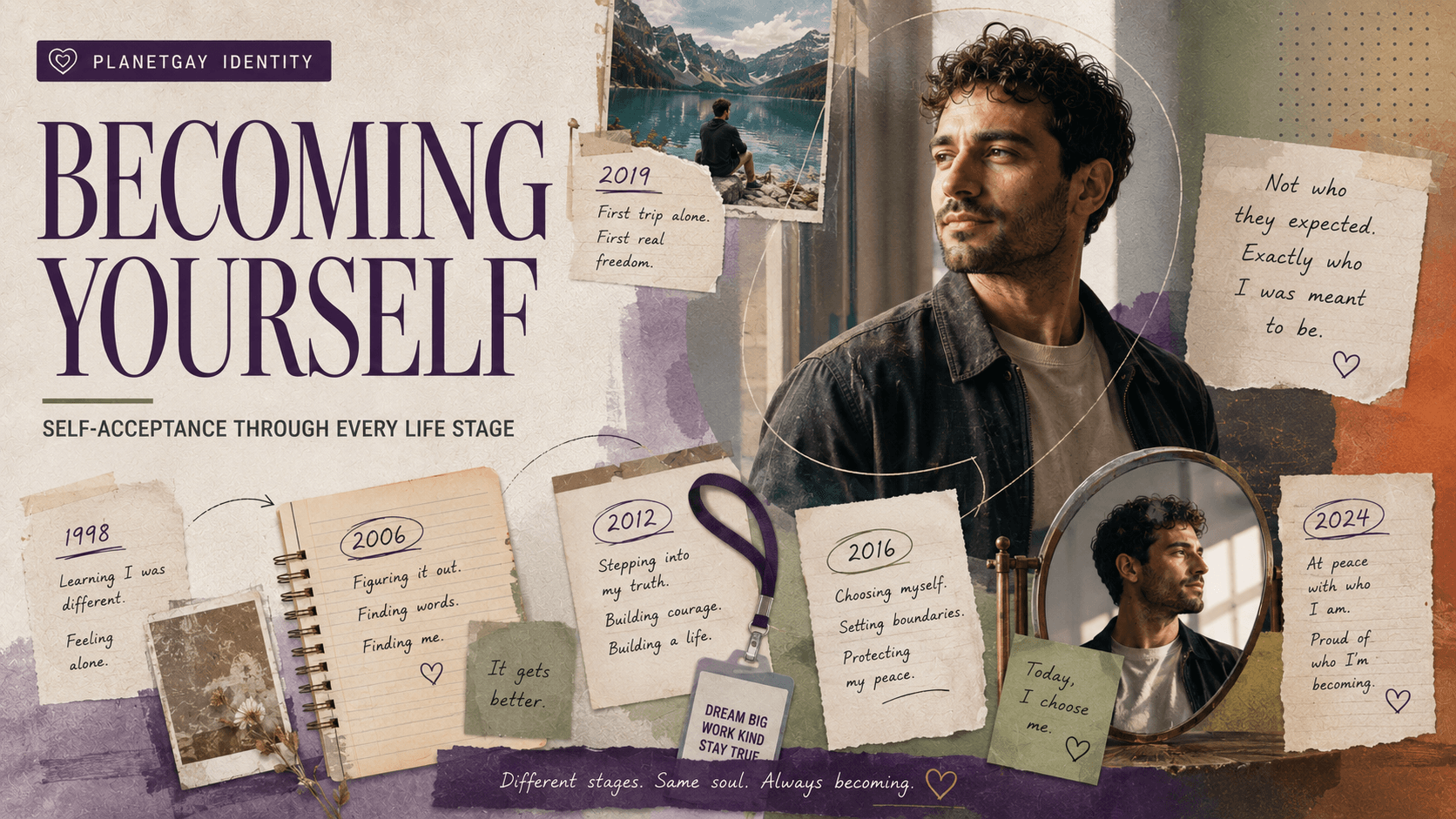
Self-acceptance is a process, not an event
There is a social narrative of coming out as a one-time event that resolves questions of identity and self-acceptance: you come out, you accept yourself, you move forward. In practice, identity and self-acceptance develop gradually, revisit earlier questions as life changes, and are not complete at any single point.
This is worth acknowledging because the 'event' narrative creates a hidden difficulty: men who are struggling with self-acceptance after formally coming out — who still feel uncomfortable, still experience shame or doubt, still don't feel fully at home in their identity — can feel that something has gone wrong, when in fact they are just at an earlier point in a normal developmental process.
Self-acceptance as a gay or bi man develops differently at different life stages. Each stage has its particular work, its particular obstacles and its particular resources.
Adolescence and early adulthood
For young gay and bi men, the central self-acceptance challenge is often about permission: the internal permission to acknowledge attraction and orientation in the face of social environments that may actively discourage it, and the growing permission to act on it.
Internalised homophobia — absorbing the negative messages that cultural environments transmit about gay people — is common and does not resolve simply through acknowledgment. Many young gay men who know and accept their sexuality intellectually still carry implicit shame or discomfort that takes time to work through.
The most effective support for self-acceptance in this stage involves visibility of positive gay lives and role models, connection with community, and environments where gay identity is genuinely normalised rather than merely tolerated.
Mid-adulthood
For men who have been out for some years, mid-adulthood brings different self-acceptance questions. These may include:
**Reconciling identity with other life structures.** For men with careers, families and social structures built around earlier versions of their life, being gay interacts with other aspects of identity in ways that require ongoing navigation rather than a settled resolution.
**Community belonging.** Not every gay man feels at home in mainstream gay culture. Men who are bisexual, who are from ethnic minority backgrounds, who are religious, who are older, who are from working-class backgrounds, or who simply don't fit the dominant visual culture of gay male spaces may find that 'gay community' doesn't include them as they expected.
**Relationship with the body.** Gay culture's relationship to appearance and the body, particularly for older men, can make self-acceptance in mid-adulthood carry specific pressures that younger men haven't yet encountered.
Later life and midlife coming out
For men who come out later in life — in their 40s, 50s or older — self-acceptance carries an additional dimension: coming to terms with the years before coming out, and what those years meant.
This can include grief — for experiences not had, for time that passed in a different life. It can include anger — at the conditions that made earlier acknowledgment feel impossible. It can include a complicated relationship with earlier choices, including marriages and relationships that may have been genuinely loving even as they were built on an incomplete self-understanding.
The self-acceptance work of later-life coming out is not only about accepting gay identity — it is also about developing an honest and compassionate account of the entire life, including the parts before coming out, rather than treating those years as simply lost.
Practical approaches to self-acceptance
Self-acceptance is developed through practice rather than reflection alone. Some approaches that consistently help:
**Visibility and connection.** Seeing other gay men living well — in relationships, in careers, as parents, as older men — provides a counterweight to the absence of positive models that many gay men grew up with.
**Community.** Regular contact with other LGBTQ+ people provides a context where gay identity is normal rather than exceptional. This matters even for men who think of themselves as confident and settled.
**Therapy.** Cognitive behavioural approaches are evidence-supported for reducing internalised shame. LGBTQ+-affirming therapists are specifically helpful — a therapist who treats gay identity as one neutral aspect of who you are, rather than as something to be treated or managed, provides a different (and more useful) experience.
**Patience.** Self-acceptance does not work on a deadline. The urgency that many gay men feel about 'getting there' is understandable and often counterproductive. The work is gradual and nonlinear, and that is normal.