Why this is worth understanding
Research consistently finds that gay and bisexual men experience anxiety and depression at higher rates than heterosexual men. This is not because being gay causes mental health problems — it is because LGBTQ+ people are exposed to chronic social stressors that straight people are not, and chronic stress has real effects on mental health over time.
The minority stress model, developed by researchers including Ilan Meyer, provides a useful framework: discrimination, concealment of identity, anticipation of rejection, and internalised homophobia all function as ongoing stressors that compound the general anxiety and stress that everyone faces. Understanding this makes the experience less mysterious and less like a personal failing — and it clarifies where change is actually possible.
This article is about everyday anxiety and stress, not a substitute for professional assessment. If anxiety is significantly interfering with your life, working with a mental health professional is the most effective path.
The specific pressure points
Gay and bisexual men face a particular set of recurring stressors, beyond the general stress of modern life:
**Concealment and vigilance.** If you are not fully out in some contexts — at work, with family, in certain social environments — managing what you reveal and to whom is a continuous, low-level cognitive load. Over time, the effort of consistent self-monitoring is genuinely exhausting, even when individual situations seem manageable.
**Anticipated rejection.** The expectation that you may face negative reactions — to your identity, your partner, your appearance, your expressions of affection in public — keeps a low-level alarm running even in situations where nothing actually happens. Vigilance itself has a cost.
**Interpersonal rejection and discrimination.** When rejection or discrimination does occur — in dating, at work, in healthcare, from family — it carries a particular weight because it targets something central to identity rather than just a superficial preference.
**Social comparison pressures.** Gay communities can carry specific pressures around appearance, body, success and social performance. These compound general social comparison anxiety.
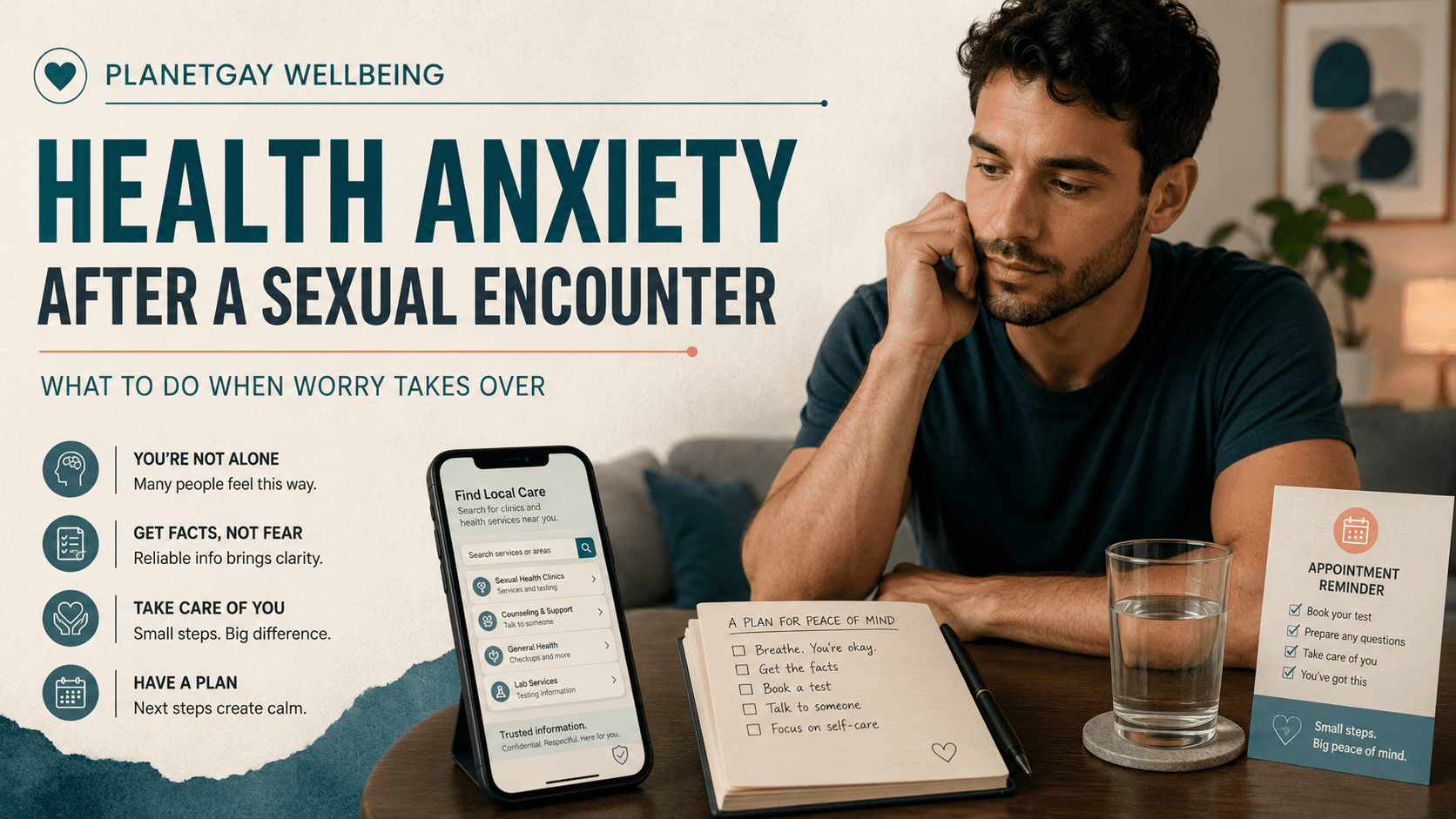
**Health anxiety.** Gay and bisexual men are more likely to have received inadequate or culturally insensitive health education and may carry greater anxiety about sexual health — sometimes beyond what the specific risk profile warrants.
Recognising anxiety and stress in yourself
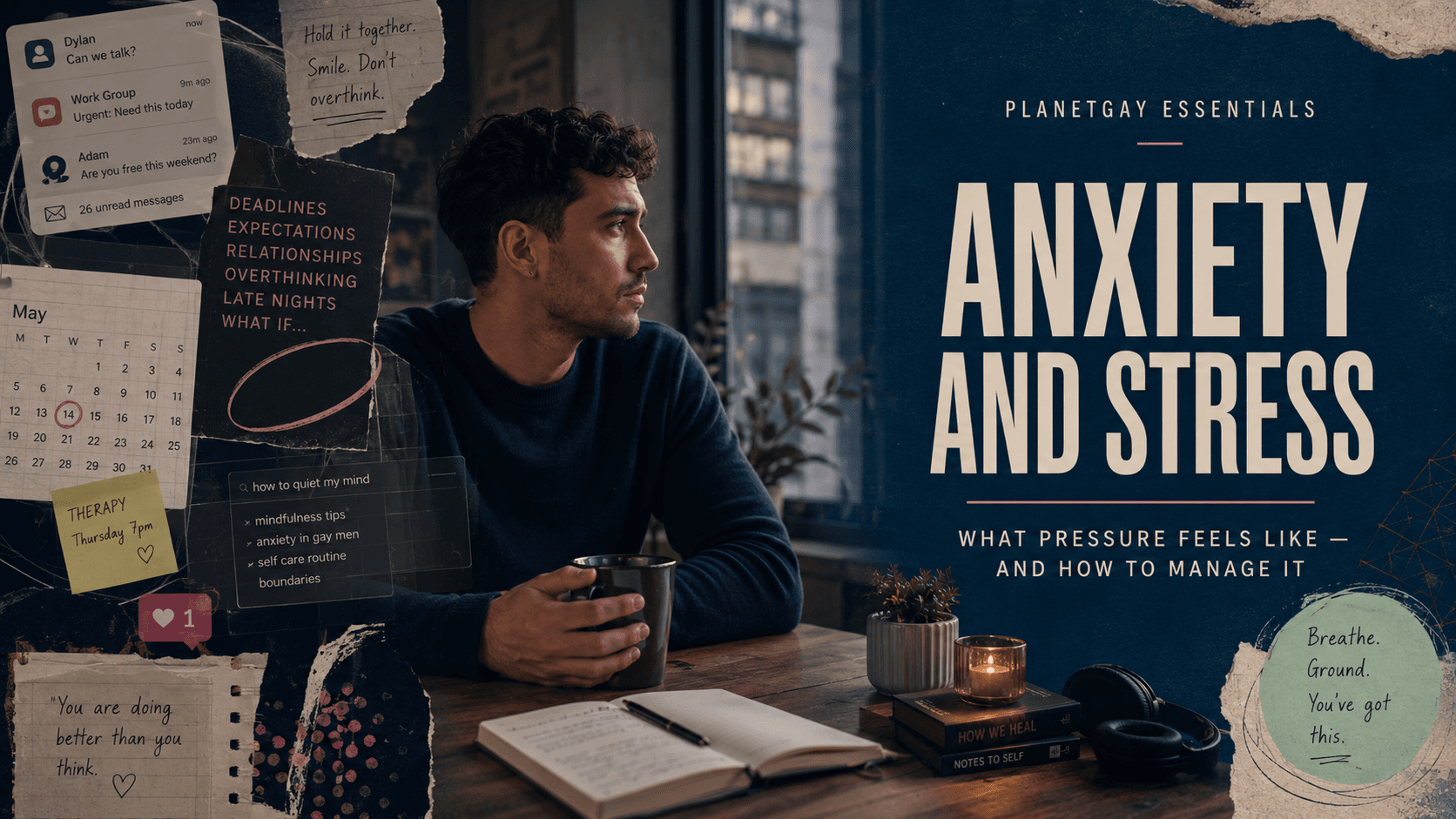
Anxiety manifests differently for different people. Common experiences include persistent worry that is hard to switch off, physical tension (muscle tightness, headaches, shallow breathing), difficulty sleeping, irritability, difficulty concentrating, and avoidance of situations that might trigger uncomfortable feelings.
Stress tends to be more situationally tied — tied to specific demands, deadlines or circumstances — while anxiety often has a more diffuse quality, attaching to one thing after another rather than resolving when a specific situation resolves.
The pattern worth paying attention to is not any single instance of anxiety but the frequency, intensity and impact on your daily life. Managing moderate, situational anxiety is one thing; managing anxiety that persistently limits what you do, whom you spend time with, or how you function at work is different.
Practical coping tools
No coping tool works for everyone, and coping strategies manage stress rather than eliminating its sources. With that in mind, the following are consistently supported by evidence:
**Physical activity.** Regular exercise has one of the strongest evidence bases for reducing anxiety and improving mood. It doesn't require a specific type — consistency across whatever form works for your life matters more than intensity.
**Reducing stimulant intake.** Caffeine increases physiological arousal and compounds anxiety for people who are already prone to it. If anxiety is an issue, monitoring coffee consumption is worth doing.
**Sleep.** Anxiety disrupts sleep, and disrupted sleep worsens anxiety. The relationship is bidirectional. Consistent sleep timing, limiting screens before bed, and addressing anything that reliably wakes you at night are all worth prioritising.
**Limiting social media and news exposure.** Constant exposure to hostile news cycles and social media comparison is a consistent anxiety driver. Setting deliberate limits on when and how much you engage is a practical tool, not avoidance.
**Connecting with people who are genuinely affirming.** Time spent with people where you can be fully yourself without vigilance has a measurable stress-reduction effect. For gay men who spend much of their week in contexts where they are managing their presentation, time in fully affirming spaces is restorative in a specific way.
When to seek professional support
Anxiety that is limiting your life — preventing you from doing things you want or need to do, consistently disrupting sleep or relationships, or producing physical symptoms — warrants professional assessment. This is not about whether the anxiety is 'serious enough.' If it is affecting your quality of life, it is serious enough.
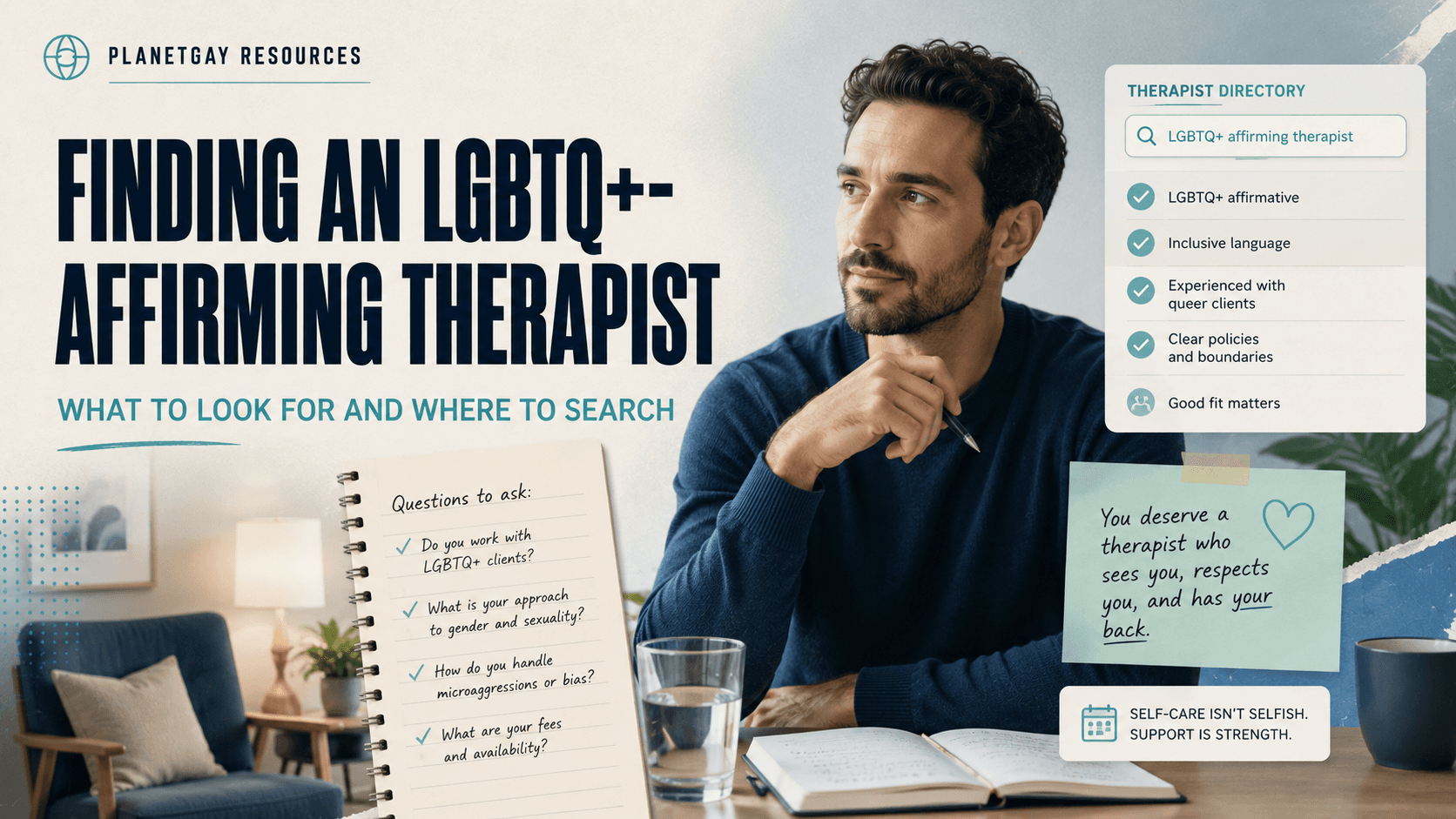
Look for a therapist who is explicitly LGBTQ+-affirming and, if possible, has specific experience with gay and bisexual men's mental health. General competence combined with limited LGBTQ+ knowledge can result in advice that misses the specific context — including treating minority stress as an individual problem to manage rather than an external stressor.
Cognitive behavioural therapy (CBT) has the strongest evidence base for anxiety. Acceptance and commitment therapy (ACT) is also well-supported. A good therapist will explain the approach and work with your specific experience rather than applying a generic protocol.
If you are in crisis or need immediate support, crisis helplines — including Switchboard in the UK (0300 330 0630) and The Trevor Project (US) — have LGBTQ+-specific services.
The limits of individual coping
Managing anxiety through individual strategies is necessary, but it is worth being clear about what those strategies can and cannot do. Coping tools address your response to stressors — they do not change the stressors themselves. Minority stress is produced by social conditions: discrimination, stigma, unequal treatment and environments that require concealment. Individual coping can make those stressors more manageable; it does not make them just.
This matters because it prevents a failure mode common in wellness discourse: treating chronic social stress as a personal failing that better self-management would solve. The anxiety that comes with managing visibility in hostile environments, dealing with discrimination, or processing internalised shame is a response to real conditions, not a character defect. Effective support acknowledges that, and works with you rather than implying that you should simply be more resilient.