Why the right therapist matters
Not all therapists are equally well-equipped to work with gay and bisexual clients. A therapist who lacks knowledge of LGBTQ+ experience, who holds unexamined assumptions about relationships and family, or who applies a heterosexual framework to LGBTQ+ lives can inadvertently make therapy less useful — or, in cases where the therapist holds beliefs that homosexuality is disordered, actively harmful.
The American Psychological Association notes in its guidelines for practice with sexual minority persons that affirmative approaches — those that recognise same-sex attraction as a normal variant of human sexuality — are important in providing appropriate care. LGBTQ+-affirming therapy is the ethical standard, not a specialty niche.
What LGBTQ+-affirming therapy actually means
LGBTQ+-affirming therapy means the therapist treats your sexual orientation and gender identity as a normal part of who you are, rather than a problem to be understood, explained or changed. It means they do not apply an implicit assumption that your goal is or should be to be heterosexual, or that same-sex relationships are inherently less valid than heterosexual ones.
It does not necessarily mean the therapist is LGBTQ+ themselves, though some clients prefer this. It means they have adequate knowledge and a non-pathologising approach to work with the specific experiences that gay and bisexual clients commonly bring: family rejection, minority stress, coming out, internalized shame, relationships, sexual health and community dynamics.
Conversion therapy — any therapy that attempts to change or suppress sexual orientation or gender identity — is harmful and has been opposed by major health organisations, including the APA, the BMA, the NHS and the Royal College of Psychiatrists. In several countries and jurisdictions it is prohibited by law.
Where to search
Several directories specifically list LGBTQ+-affirming therapists or therapists with LGBTQ+ specialism:
In the UK, Pink Therapy (pinktherapy.com) is a directory of therapists and counsellors with specific training in LGBTQ+ issues. The BACP (British Association for Counselling and Psychotherapy) therapist directory allows filtering by specialism, which can include LGBTQ+ experience.
In North America, Psychology Today's therapist finder (psychologytoday.com/us/therapists) allows filtering by issues and community, including LGBTQ+-related specifics. TherapyDen (therapyden.com) has a specific LGBTQ+-affirming filter.
In Canada, the Canadian Counselling and Psychotherapy Association has a therapist directory. LGBTQ+-friendly mental health services also exist through community health centres in most larger cities.
In other countries, LGBTQ+ organisations often maintain local referral lists, or can advise on finding appropriate support.
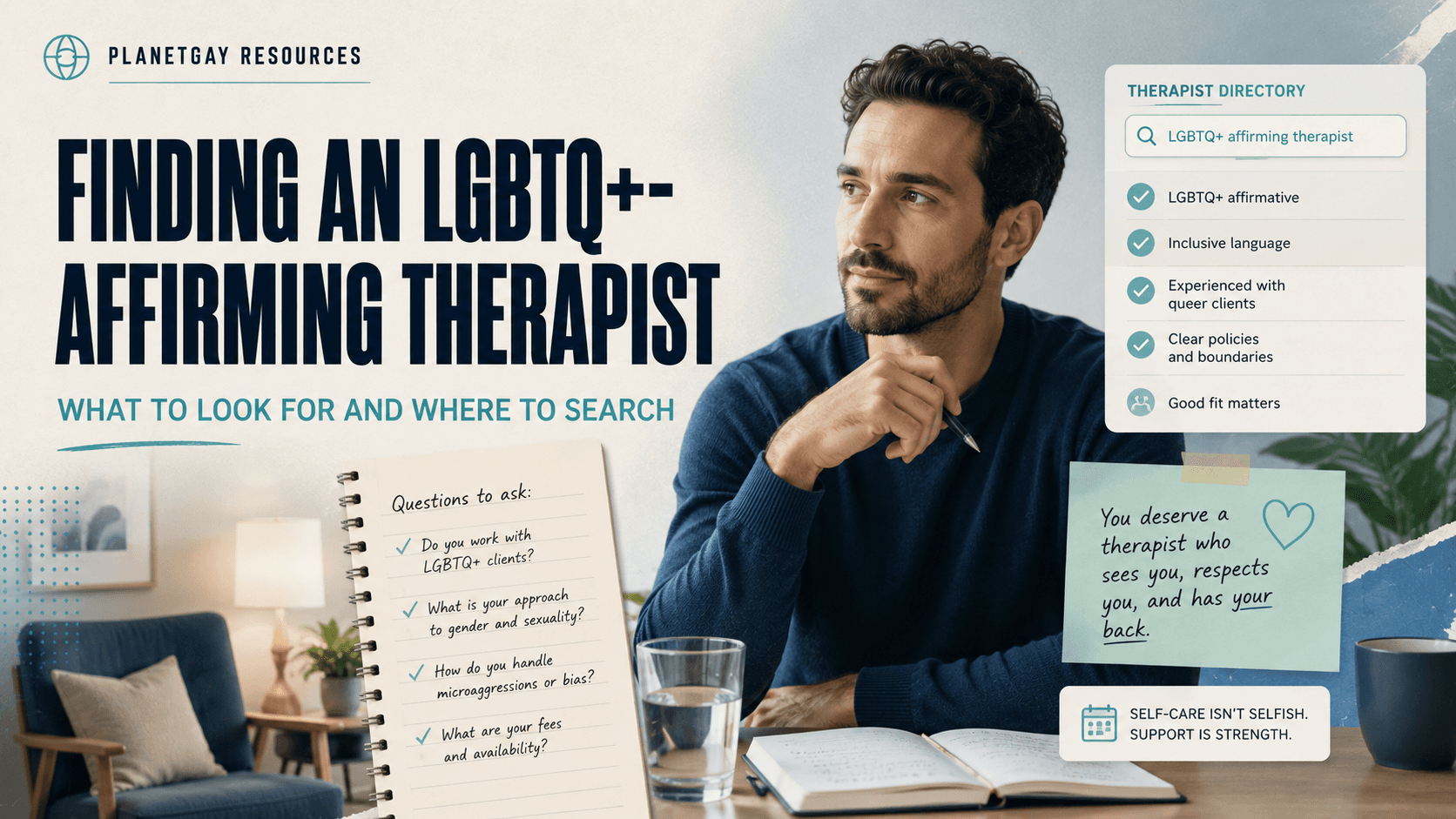
What to ask a potential therapist
Before committing to work with a therapist, most people have a brief introductory call or first session. This is an opportunity to assess whether the therapist is the right fit. Some questions worth asking:
'Do you have experience working with gay and bisexual clients?' A confident, specific answer is a good sign. Vagueness or a defensive response is not.
'What is your approach to working with LGBTQ+ issues?' Look for a response that treats LGBTQ+ identity as normal and focuses on the specific challenges rather than on the identity itself.
'Have you done any specific training in LGBTQ+-affirming practice?' This is not essential, but it is useful information.
You are also looking for the general sense of whether you can speak openly with this person. A therapist who makes you feel self-conscious or who responds to information about your life with surprise or awkwardness is not the right fit, regardless of their stated position on LGBTQ+ issues.
Cost and access
Therapy costs vary enormously. In the UK, therapy is available through the NHS (typically via GP referral, with waiting times that vary by area) and through LGBTQ+ community organisations that provide lower-cost or sliding-scale options. Many LGBTQ+ charities and community health centres in the UK provide counselling services.
In Canada, coverage varies by province; some therapy costs are covered by provincial health plans, and many community health centres provide low-cost therapy. In the United States, therapy costs vary widely based on insurance, and many therapists offer sliding-scale fees. Community health centres and LGBTQ+ organisations often provide lower-cost options.
If cost is a significant barrier, LGBTQ+ community organisations are often the most direct route to lower-cost or free mental health support, alongside peer support programmes which, while not therapy, can provide meaningful community and shared experience.
When it's not working
If you start working with a therapist and find that the relationship is not right — that they make assumptions about your identity, that they bring visible discomfort to discussions of your sexuality, that you are managing their reactions rather than focusing on your own — it is appropriate to end the working relationship and find a different therapist.
Changing therapist is not a sign of failure. Finding the right therapeutic relationship sometimes takes more than one attempt. The first sign that a therapeutic relationship is not working well — discomfort with how they respond to your identity, a sense that you can't fully say what is true — is worth taking seriously rather than normalising.