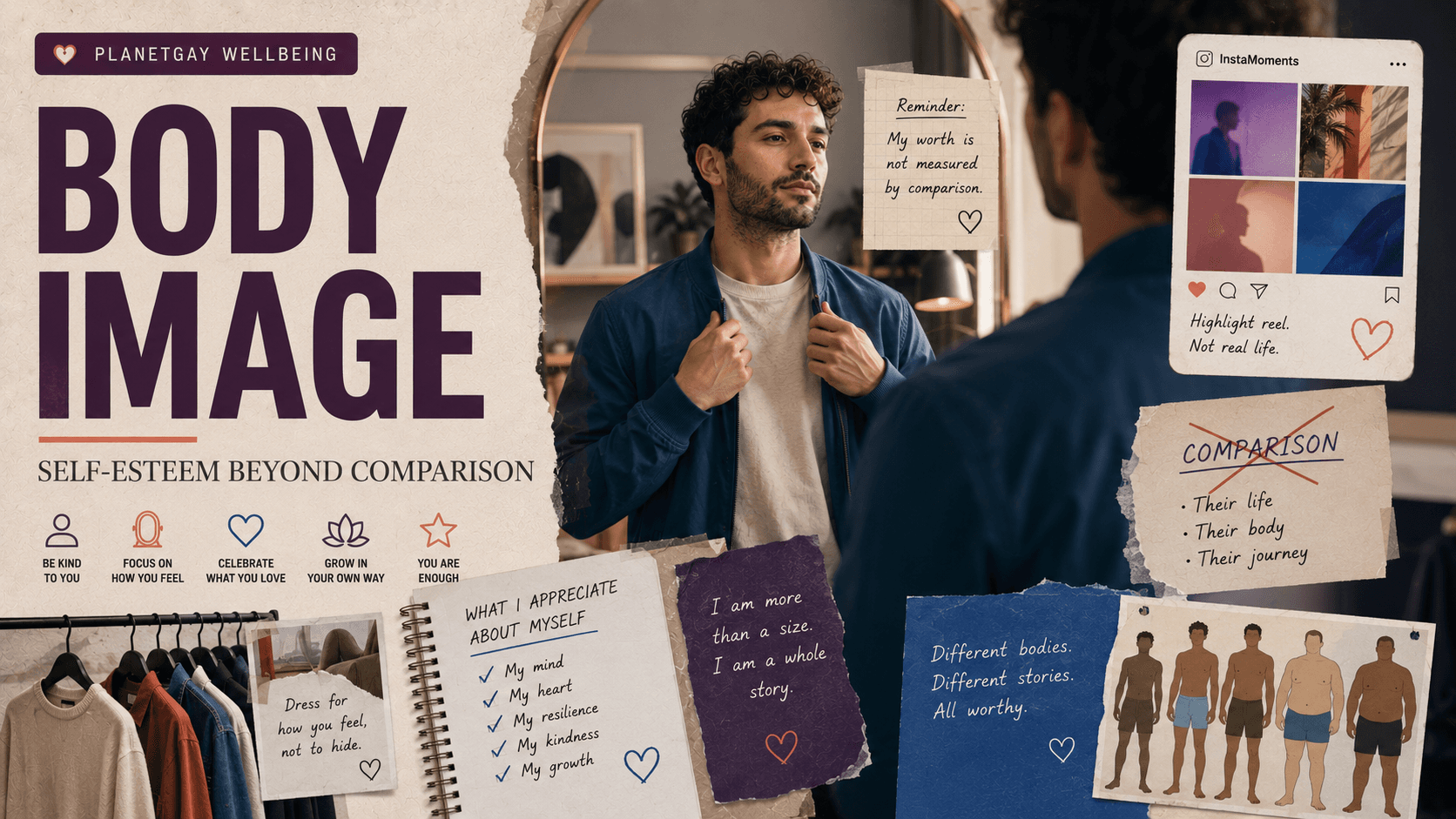
Why body image is a specific issue in this context
Body image concerns are common across genders and sexual orientations, but research consistently finds elevated rates among gay and bisexual men compared to heterosexual men. This is not a coincidence or a weakness. It reflects specific cultural pressures: gay male culture has historically placed high value on physical appearance in ways that create a particular environment, particularly in the contexts where gay men socialise and date.
App-based dating amplifies this by structuring the first filter as a photograph. Regular exposure to a large pool of potential partners, all presented primarily through physical image, creates comparison that can affect how people see themselves. The American Psychological Association and mental health organisations including Mind both acknowledge body image and appearance pressure as factors affecting the wellbeing of gay and bisexual men.
What poor body image looks like in practice
Body image concerns show up in a range of ways, not all of them immediately recognisable as such. Some common expressions: avoiding mirrors or, conversely, checking compulsively; not dating or pursuing connection because you believe your body is not good enough; investing heavily in changing your body while the anxiety persists regardless of what changes; feeling significantly worse after opening a dating app; declining social invitations that involve being seen in swimwear or sportswear; or filtering how you feel about yourself through how much you feel others find you attractive.
These are not character flaws. They are patterns that develop in response to specific cultural environments, and they are worth recognising as patterns rather than as objective assessments of your body.
The connection to shame
Body image concerns in gay men often intersect with broader experiences of shame — about sexuality, about not conforming to norms, about visibility. For some men, the body becomes a site where older, more diffuse shame gets focused into something concrete and alterable. If you can fix your body, the implicit promise runs, you might also fix the underlying discomfort. This does not work, which is one reason why body-focused pursuits — gym regimes, diets, surgery — can escalate in intensity without resolving the feeling.
Recognising when body concerns are carrying this additional weight — when the real issue is not your body at all but something underneath it — is a step that therapy or counselling can help with. The body focus can be a way of managing something that doesn't have a clear physical solution.
Diet, exercise and obsession
Exercise and attention to nutrition are healthy behaviours. They become a problem when they are driven primarily by anxiety rather than by enjoyment or genuine health goals, when they significantly constrict daily life, or when the standard for what counts as 'enough' keeps moving upward regardless of actual progress.
Eating disorders affect men across sexual orientations, but rates are higher among gay and bisexual men than in the general male population, according to research cited by the National Eating Disorders Association and echoed in UK eating disorder charity Beat's resources. This guide is not a clinical resource for eating disorder assessment — if you are concerned that your relationship with food or exercise has become disordered, speaking to a GP or a specialist service is the appropriate step.
This article is educational and does not constitute medical advice. A clinician can assess whether specialist support is needed.
When professional support is warranted
Professional support is worth seeking if: body image concerns are significantly affecting your daily life, your relationships or your ability to eat and exercise healthily; if the concerns are connected to significant depression or anxiety; if you have thoughts about self-harm connected to body dissatisfaction; or if your relationship with food or exercise has developed features that feel out of control.
In the UK, Beat (beateatingdisorders.org.uk) provides support for eating disorders and body image concerns. Your GP is also a starting point for a referral to relevant services. In seeking a therapist for body image work specifically, looking for someone who has experience with gay male clients and with body image or eating disorder issues produces better outcomes than a general referral.
This article is not medical advice. If you are concerned about your mental or physical health in relation to body image, a GP or mental health clinician is the appropriate first contact.

Social media and comparison
Social media platforms — including dating apps but also broader social platforms — surface a disproportionate number of images of bodies that represent a narrow aesthetic ideal. This is a feature of how these platforms work, not a random sample of how people look. What you are seeing is filtered by algorithm toward the images that generate the most engagement, which are not representative of ordinary variation.
Knowing this intellectually and feeling it are different things. But the fact that the diet of images you are consuming is heavily curated toward specific body types is relevant context for any self-comparison. Reducing social media consumption — particularly during periods when body image is already a preoccupation — tends to reduce the intensity of negative comparison.