Medical disclaimer
This article is general informational content only. It does not provide medical diagnoses or guarantee your health status. If you believe you have been exposed to HIV or another STI, contact a healthcare provider rather than relying on this article. For potential HIV exposure within 72 hours, PEP (post-exposure prophylaxis) is a time-sensitive medical option — contact a sexual health clinic, A&E, or call 999/911 immediately for current guidance.
What health anxiety after sex looks like
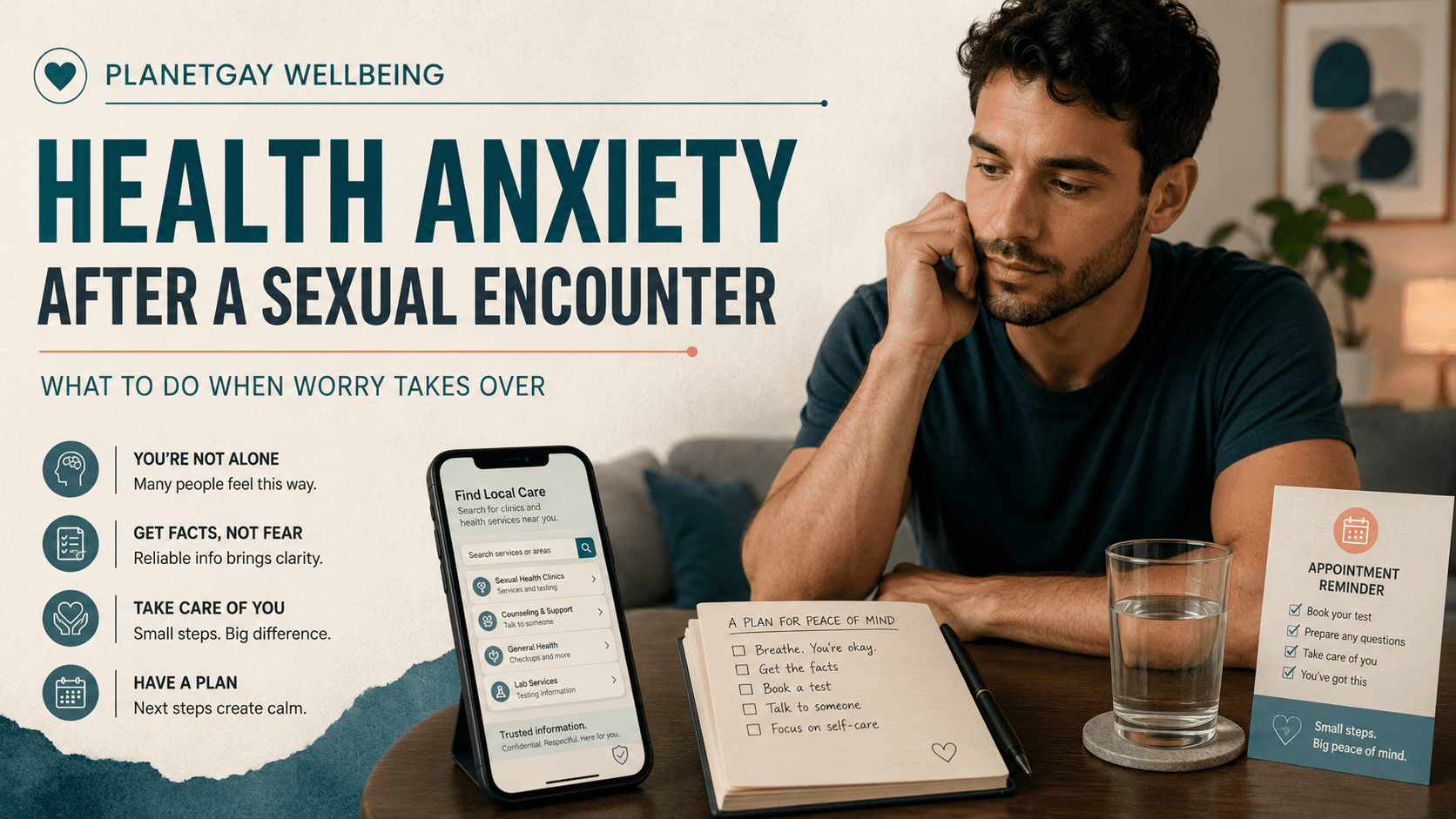
Health anxiety following a sexual encounter typically has a specific pattern: something about the encounter felt higher-risk than usual; anxiety begins to build; the person starts searching for information online; symptoms (real or imagined) begin to feel significant; the searching intensifies; reassurance provides temporary relief that is quickly replaced by renewed anxiety.
This pattern is recognisable as a health anxiety loop. It is not primarily about the actual risk involved in the encounter — health anxiety can develop after encounters with genuinely low risk, and can involve disproportionate concern relative to the actual exposure. The anxiety has its own internal logic that is only partly connected to actual risk.
For gay and bisexual men, health anxiety around sexual health — particularly HIV — is a specific and well-documented pattern. The historical context of HIV and gay communities, and the cultural weight of HIV in gay identity and community experience, can amplify anxiety beyond what a rational risk assessment would produce.
Distinguishing real concern from anxiety
Not all anxiety after a sexual encounter is health anxiety in the clinical sense. Some concern is appropriate and should prompt testing. The distinction lies in whether the response is proportionate to the actual risk and whether it leads to helpful action (getting tested, seeking PEP if appropriate) or an escalating loop of reassurance-seeking that doesn't resolve.
Situations that warrant contacting a healthcare provider directly:
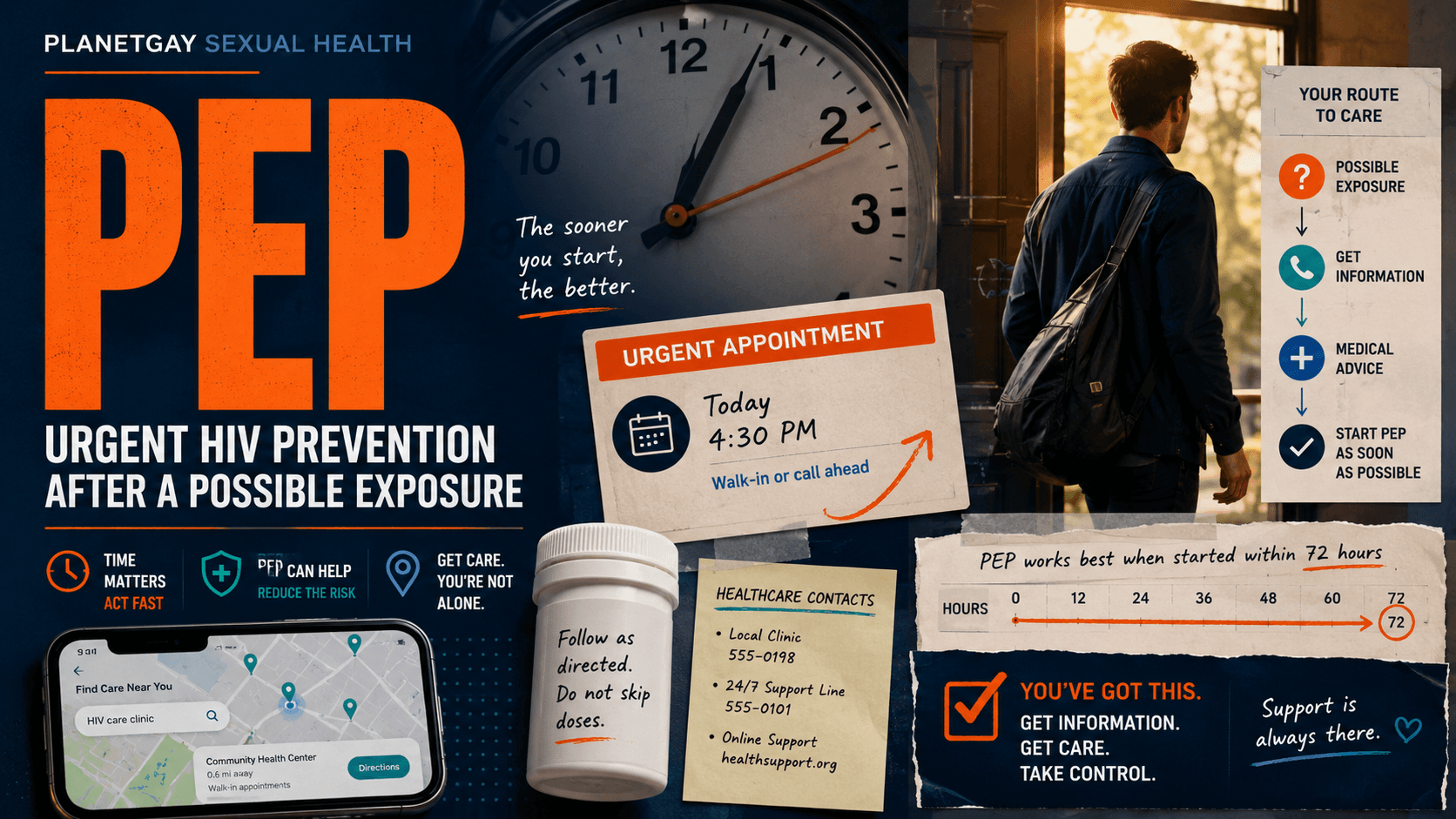
**Within 72 hours of potential HIV exposure:** PEP (post-exposure prophylaxis) is a time-sensitive treatment option. Contact a sexual health clinic, A&E, or call emergency services for current guidance. Do not spend those 72 hours reading about PEP online — use them to access the treatment if it is appropriate for your situation.
**Any symptoms you cannot explain:** If you have symptoms — rash, unusual discharge, pain, sores — that you cannot attribute to something else, these warrant clinical assessment. Do not self-diagnose.
**Specific known exposure:** If you know you had unprotected sex with someone who is HIV-positive and not virally suppressed, or if you have been informed by a partner about an STI, testing and potentially treatment are the appropriate responses.
For situations that do not meet the above criteria — anxiety about an encounter that was lower-risk, without specific known exposure, without symptoms — the helpful path is different.
Why seeking reassurance online makes it worse
The most common response to health anxiety is online searching — looking for information that will either confirm the fear or definitively reassure. Both outcomes tend to be temporary. If you find reassuring information, the relief lasts a short time before a new worry emerges. If you find alarming information, anxiety escalates.
Online health searching also introduces a specific problem: the information found is often a mix of accurate clinical information, outdated information, worst-case scenarios, and other people's anxiety expressed as reported symptoms. None of this is a substitute for clinical assessment, and the process of searching typically makes the anxiety worse rather than better.
The principle in managing health anxiety is to reduce reassurance-seeking rather than to find better reassurance. This feels counterintuitive but is supported by the research on health anxiety management, including approaches based on cognitive behavioural therapy (CBT). Recognising the reassurance loop and choosing not to continue it is the first step.
What actually helps
For acute health anxiety after a sexual encounter:
**Test, then wait.** If the encounter was genuinely in a window period where testing would be meaningful (HIV test at 45 days or more after exposure for a definitive result; earlier testing can detect many infections sooner), test. This is the one reassurance that has a basis in clinical reality. If you test and the result is negative at the appropriate testing window, that is medically meaningful information.
**Set a limit on searching.** Decide before you start that you will look up clinical information once, from a reliable source (NHS, CDC, your sexual health clinic), and not continue searching. This is difficult when anxiety is high; it is the appropriate limit.
**Contact a healthcare provider for clinical questions.** If you have a specific clinical question — 'what is the risk from this specific type of unprotected contact?' — a sexual health clinician can provide a calibrated assessment. This is a one-time question, not a repeated reassurance-seeking loop.
**Address the underlying anxiety pattern.** If health anxiety after sexual encounters is a recurrent pattern for you — happening after encounters that you know carry low risk, recurring despite previous testing and negative results — this is worth addressing as a mental health concern rather than a sexual health concern. A therapist with experience in health anxiety and CBT can help interrupt the loop.
Regular testing as a foundation
One practical foundation for managing anxiety around sexual health is a regular testing schedule that doesn't wait for anxiety to motivate it. The NHS recommends gay and bisexual men who are sexually active with multiple partners test at least every three months for HIV and STIs. Being in a regular testing rhythm — testing because it is a scheduled health maintenance action, not because anxiety has spiked — removes the 'am I at risk' uncertainty and replaces it with known, current clinical information.
Regular testing also reduces the significance of any individual encounter: if you test every three months, any one encounter is within a known, bounded period. This is not a guarantee of safety, but it is a rational structure for managing risk that tends to reduce anxiety over time compared to testing only when anxiety spikes.