What family rejection looks like
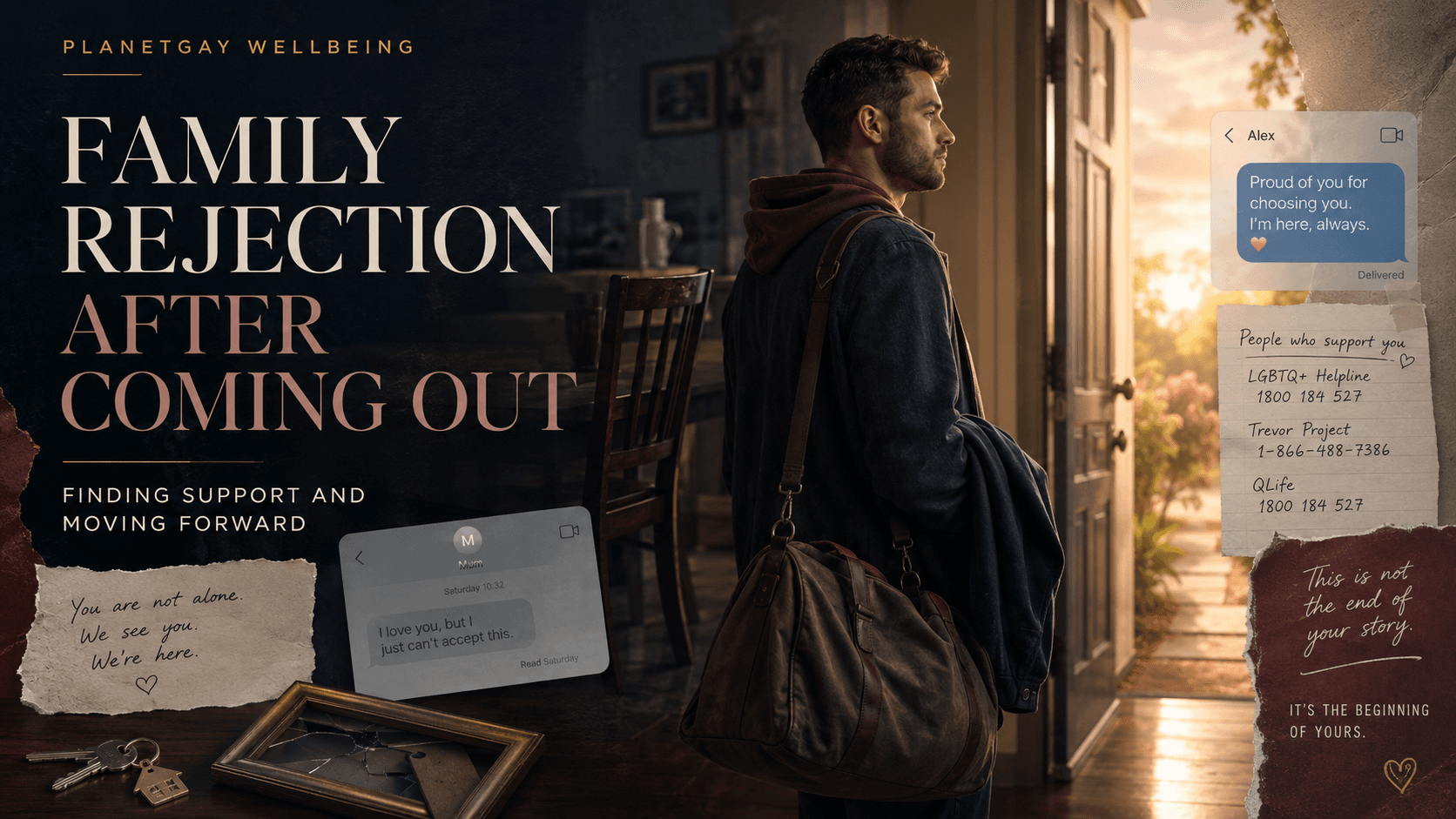
Family rejection after coming out is not a single event. It exists on a spectrum: from a temporary withdrawal and difficult first reactions, to deliberate ongoing silence, to explicit communication that the person is no longer welcome, to removal of financial or housing support, to threats or violence. These are different situations that require different responses.
The Trevor Project's research into LGBTQ+ youth and family acceptance consistently identifies family rejection as a significant risk factor for depression, anxiety and self-harm among LGBTQ+ young people. The same dynamics affect adult men — the loss of family connection, or the conditional nature of family acceptance, is a real and substantial grief regardless of age.
Immediate priorities
If rejection has led to loss of housing — a situation that affects a disproportionate number of LGBTQ+ people — your immediate priority is securing somewhere safe to stay. LGBTQ+ youth homelessness services exist in many cities; in the UK, services including Albert Kennedy Trust work specifically with LGBTQ+ young people who are homeless or at risk of homelessness. For adults, general housing and homelessness services, as well as LGBTQ+ community organisations, may be able to advise on options.
If the rejection has involved threats or violence, contact police or a domestic violence support service. Being rejected by your family is painful; being threatened or harmed is a safety situation that requires immediate response.
If you are in a situation of acute distress — particularly if you are having thoughts of self-harm or suicide — contact a crisis service: the Samaritans in the UK (116 123), the Trevor Project in the US (1-866-488-7386 or text START to 678678), or local emergency services. Your safety is the first priority.
Building an alternative support network
When family support is withdrawn or becomes conditional, building alternative support becomes urgent. For many LGBTQ+ people, chosen family — friends, community members, partners — fulfils the function that biological family cannot.
This takes time to build, and it is harder to do when you are in the middle of grief and distress. But identifying the people who are already present and affirming — even if they are not yet a close network — and investing in those relationships is a realistic starting point. LGBTQ+ community organisations, peer support groups and social groups oriented toward LGBTQ+ people all provide contexts where these connections form.
If you have no LGBTQ+ community connections yet, online communities, LGBTQ+ helplines and peer support programmes can function as a bridge while you build in-person connection.
The grief of family rejection
Family rejection is a loss, and it produces grief — sometimes grief that does not behave the way ordinary grief does, because the person or people you are grieving are still alive and in the world. The ambiguity of that situation — not mourning a death, but mourning a relationship or a version of a relationship — can make it harder to process.
It is normal to cycle through anger, sadness, numbness, hope when small positive signals occur, and disappointment when those signals don't lead anywhere. It is also normal to feel grief and relief simultaneously — relief at no longer hiding, grief at what the honesty cost.
Therapy with an LGBTQ+-affirming therapist who is experienced with family rejection dynamics can provide a place to process this that is better than doing it alone. Mind in the UK and the Trevor Project in the US both provide referral and support resources.
When family relationships might repair
Some families who reject initially do repair over time, particularly when they have support of their own and are not required to change overnight. Research by the Family Acceptance Project (familyproject.sfsu.edu) at San Francisco State University has found that family acceptance — even partial and gradual acceptance — significantly improves LGBTQ+ young people's mental health outcomes compared to full rejection. This suggests that encouraging family members to access support (organisations like PFLAG in North America, or Families and Friends of Gay Men and Lesbians) is worth doing where it is safe to do so.
Not all families repair. Some do not. Accepting that a particular family will not change — and orienting your life around that reality rather than waiting for a change that will not come — is painful but often more sustainable than sustained hope for a repair that is not coming.
Longer-term wellbeing
The longer-term effects of family rejection — on self-worth, on the capacity for trust, on attachment patterns in relationships — are real and do not always resolve without some attention. Many men who experienced family rejection find that its effects show up years later in unexpected places: difficulty trusting partners, difficulty asking for support, a persistent sense of conditional belonging.
Professional support that takes the specific context of LGBTQ+ family rejection seriously — rather than treating it as a generic family difficulty — tends to be more useful. Some therapists specialise in this area. Peer support from other gay men who have navigated similar experiences can also be significant.
Living well after family rejection is possible. It often requires building a life that does not depend on family approval for its foundation — and that building tends to be an active project rather than something that happens automatically.