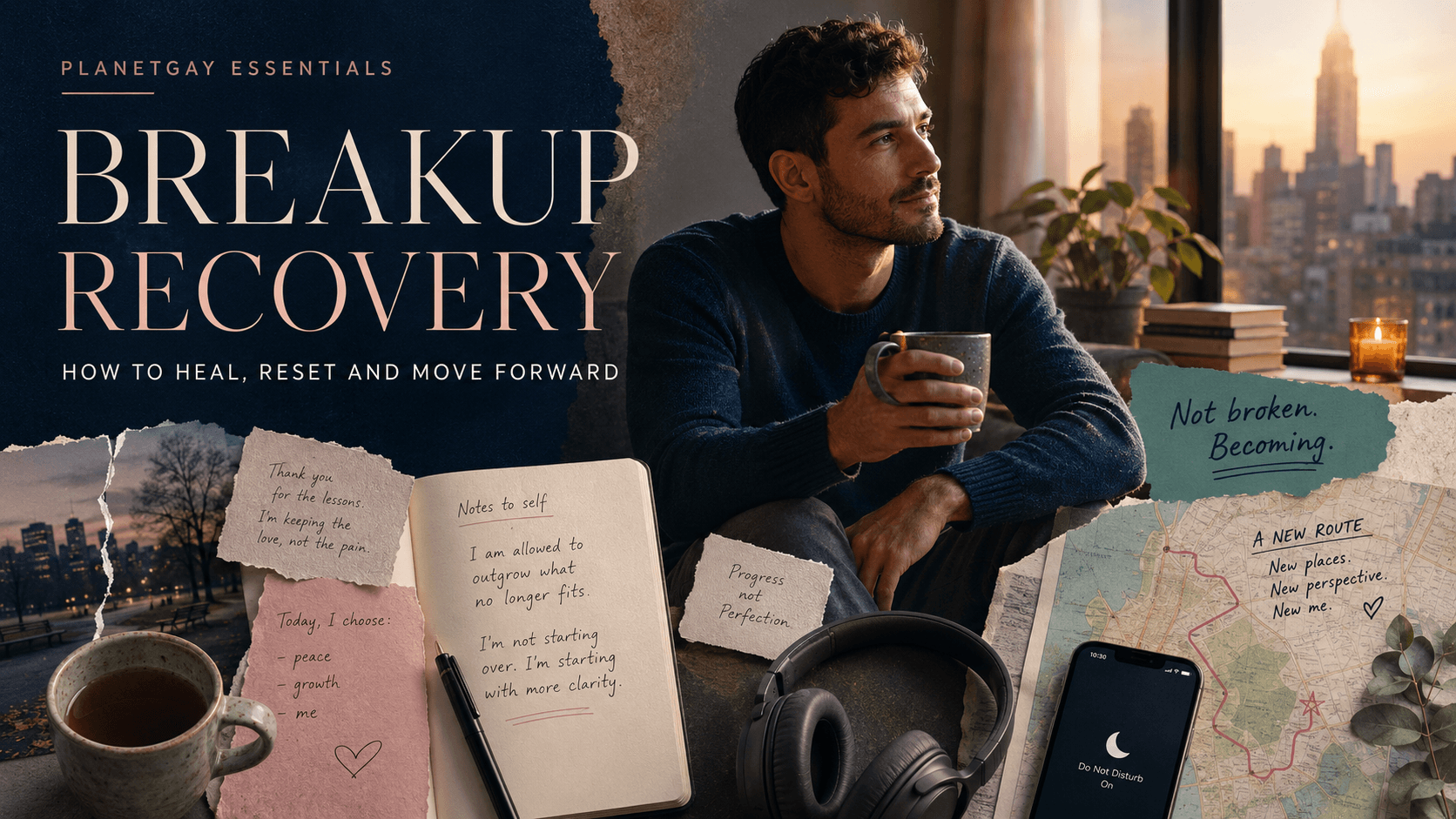
Why breakup recovery is different for gay men
The end of a serious relationship produces grief regardless of orientation. But gay men often navigate that grief with fewer of the social structures that heterosexual people have access to, and with some specific complications that are worth naming.
First, the support network. Gay men often have smaller local friendship networks than straight men, particularly those who came out later, who live in less LGBTQ+-concentrated areas, or whose support network was heavily tied to the relationship. When the relationship ends, a significant source of social connection may go with it.
Second, the ex may remain a significant part of the shared social scene. In smaller LGBTQ+ communities, an ex-partner is often in the same spaces, connected to the same people, and may continue to be present in contexts you cannot easily avoid. The physical and social separation that breakup recovery often requires is harder to achieve.
Third, for some gay men, an intimate relationship is the primary space where they could be fully themselves — where their sexuality and their full identity were not managed or concealed. The loss of that space adds a specific dimension to the grief.
The early period: what to expect
Grief after a serious relationship ends is not linear and does not follow a set timeline. What most people experience includes: periods of acute distress that come in waves rather than continuously; temporary improvement that can feel like recovery followed by another dip; grief that is triggered not by thoughts about the person but by ordinary situations — a place you went together, a song, a meal. This pattern is normal and does not mean you are doing it wrong.
In the first weeks, the most useful orientation is not recovery — it is stabilisation. This means: maintaining basic routines (sleep, food, movement) when the temptation is to abandon them; limiting decisions that cannot wait; being selective about what you take in socially and whether it is actually helpful; and not treating acute grief as evidence that you need to change your view of the relationship.
Avoid making major decisions in the acute phase. The perspective you have in the first few weeks is not your settled perspective.
Rebuilding your own life
Recovery is partly about processing loss and partly about rebuilding a life that is yours again. The latter takes active effort after a significant relationship, because in any long partnership, habits, preferences, social patterns and even self-understanding become entangled with the relationship.
Some of this is straightforward: reclaiming the routines, hobbies and activities that you let slide during the relationship, or that you shaped around your partner. Some is more gradual: working out what you actually want — from friendships, from where you live, from your work and leisure life — rather than defaulting to the preferences that the relationship produced.
This does not have to be framed as 'rediscovering yourself' (a phrase that tends toward cliché). It is more simply a practical question: what do I want, and what is in my way? Answering that takes time, and is easier to do when the acute grief has begun to settle.
When and how to get support
Grief after a serious relationship end is not a mental health problem, and most people work through it without professional support. But there are circumstances where a therapist is useful: if the grief is significantly interfering with functioning over an extended period; if the relationship involved significant trauma, coercion or abuse that is now surfacing; if you find yourself in patterns (drinking to manage the pain, withdrawing completely, ruminating without any movement) that are not self-correcting.
An LGBTQ+-affirming therapist who understands the specific context — smaller networks, shared community, the complexity of gay relationships — is likely more useful than general grief support. The BACP (UK) and Psychology Today (US) directories allow filtering for LGBTQ+ specialists.
Friendship is valuable, but not sufficient on its own when what you need is to say the same thing repeatedly to someone who isn't tired of hearing it. That is what a therapist provides.
Looking forward without rushing
The cultural pressure to 'get back out there' is not always useful advice after a serious relationship ends. Dating before you have genuinely processed what happened tends to produce one of two outcomes: repeating the same dynamic with a new person, or using dating as an emotional distraction that delays recovery.
There is no correct timeline for when to start dating again. The useful question is not 'when did others say was right?' but 'am I interested in a new relationship on its own terms, or am I trying to fill a specific gap?' If the answer is the second, a bit more time — and often more productive use of that time — is usually the better choice.
When you do return to dating, the experience of the previous relationship is not wasted. Knowing more clearly what you want and do not want, what patterns you want to avoid, and what you actually value in a partner is genuinely useful information — if you have done enough of the actual recovery work to access it clearly.