Conflict is not the problem
The presence of conflict in a relationship does not indicate a problem — the absence of it often does. Couples who never argue are usually couples where one or both partners are suppressing rather than expressing, and suppressed conflict tends to emerge as distance, resentment or eventual eruption.
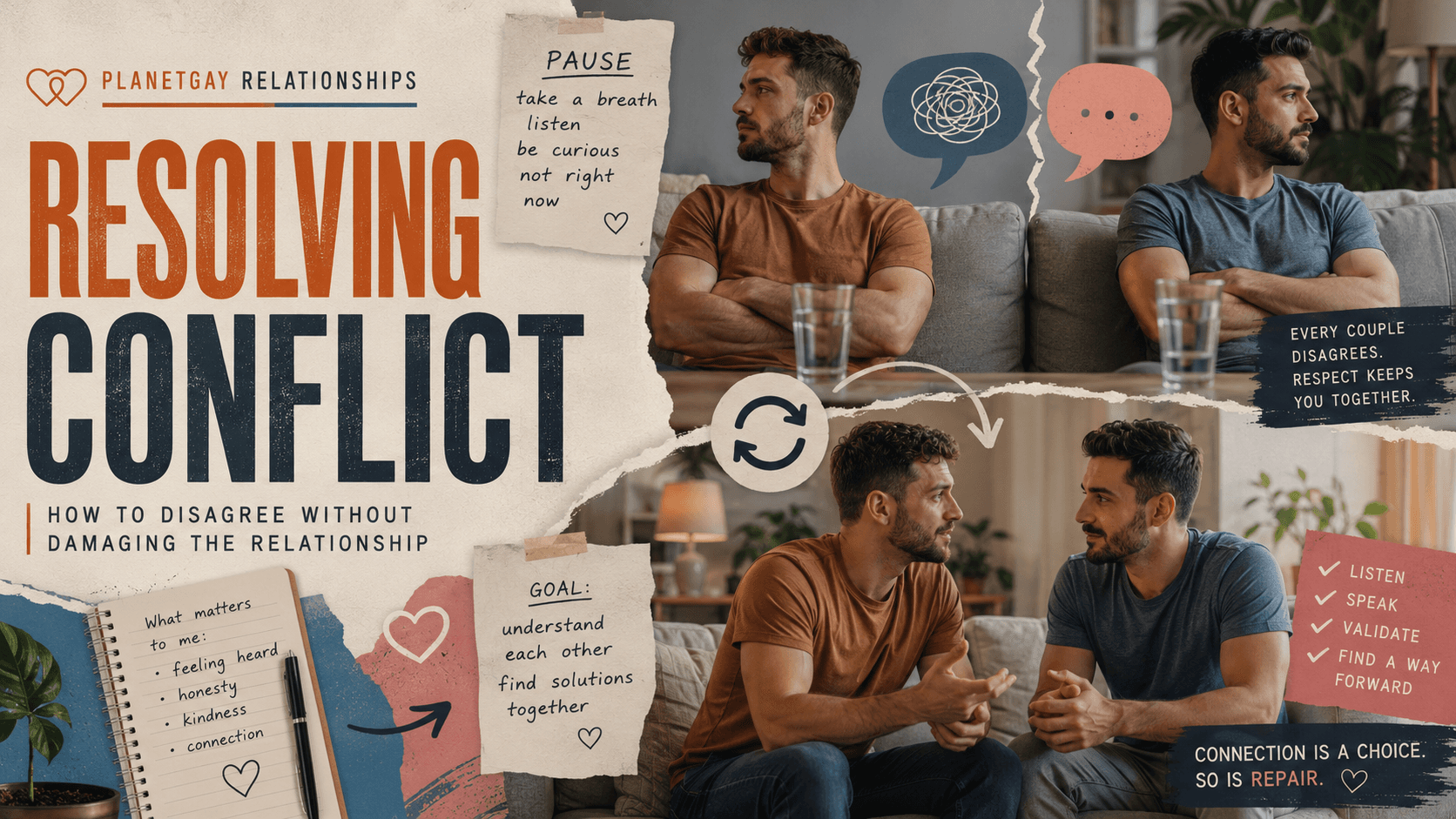
What matters is not whether conflict occurs but how it is handled — whether both partners can express what they need, hear what the other needs, and work toward resolution without the conversation deteriorating into contempt, stonewalling or prolonged escalation. The goal is not conflict avoidance but conflict competence.
De-escalation: intervening before it gets worse
Many arguments escalate not because the original issue is large but because the conversation spirals — each partner responding to the escalated form of what the other said rather than the original concern. Interrupting this spiral is a skill.
The most effective de-escalation interventions:
**Name the process rather than continuing it.** 'I notice we're getting louder and I don't think this is going anywhere useful — can we pause?' acknowledges what's happening without making it another accusation.
**Agree to a pause.** If a conversation has escalated beyond useful, agreeing to a defined pause — 'I need 30 minutes, then I'd like to come back to this' — gives both partners time for the physiological arousal of conflict to reduce. The pause only works if you actually return; 'let's talk later' without a specific time is often avoidance.
**Do not pursue a partner who has withdrawn.** If your partner has gone quiet or left the room, following them to continue the argument typically escalates rather than resolves. Give them the space and come back when both of you are calmer.
Repair attempts: what they are and how to make them
A repair attempt is any action — verbal or non-verbal — that tries to reduce tension and return the conversation to connection during or after conflict. Research by relationship psychologists has found that the ability to make and accept repair attempts is one of the strongest predictors of relationship health.
Repair attempts include: humour (carefully, and not minimising the issue), acknowledgement ('you're right that I didn't handle that well'), physical touch, naming the dynamic ('we're going in circles — can we start again?'), or a direct statement of care ('I'm really angry right now but I love you and I want to work this out').
For repair attempts to work, the receiving partner needs to be able to accept them — which requires noticing them and choosing to engage rather than staying in the defensive/aggressive posture. The ability to make and receive repairs develops with practice.
Recurring arguments: what they signal
If the same argument keeps recurring — the same topic, the same dynamic, the same unresolved frustration — it is usually a signal that the underlying issue has not been addressed, only the surface argument has been managed and dropped.
Addressing recurring arguments requires identifying the underlying need: what does each partner actually need here, and is it being heard? The argument about the dishes is often not about the dishes — it is about feeling like contributions are not valued, or about different standards, or about a power dynamic neither partner has named.
This reframing requires coming back to the issue after emotions have settled, rather than during or immediately after conflict. 'I want to talk about what keeps happening with X, not in the heat of the moment but when we're both calm — can we do that?' is a productive approach.
Safety: when conflict crosses a line
Conflict in a relationship is normal. Coercion, control, intimidation or physical harm are not conflict — they are abuse. For gay men, domestic violence in same-sex relationships is documented and under-reported, in part because social norms around male-to-male violence are different and in part because the available services are not always visibly accessible.
If a conflict regularly involves threats, physical contact intended to harm, deliberate humiliation, or patterns of control over money, movement or social contact — this is not a communication problem to solve with better conflict skills. Support is available through organisations including Galop in the UK (galop.org.uk, 0800 999 5428), a specialist LGBTQ+ anti-violence charity, and the National Domestic Violence Hotline in the US.
When couples counselling helps
Couples counselling is most useful when the same patterns keep recurring despite both partners' genuine effort, when the conversation about specific issues has become so charged that it can't happen without escalation, or when trust has been significantly damaged and needs structured support to be rebuilt.
It is least useful — and sometimes harmful — in relationships where coercion or abuse is present, because the counselling format can be used by an abusive partner to further control the situation. Individual support takes priority in those cases.
Look for a therapist who is LGBTQ+-affirming and, if possible, has experience with gay male couples specifically. The specific social context — minority stress, smaller community dynamics, potential outness differences — is relevant to how conflict manifests and how to address it.