Why the conversation is different
For same-sex couples in the countries where marriage equality exists, the conversation about marriage is in some ways the same as for any couple: what does commitment mean to each person, do they want legal recognition of the relationship, do they want the ceremony and the social event, and are they on the same page about when?
But it also carries some specific dimensions. Many gay men grew up in contexts where marriage was explicitly not an option — where same-sex relationships were legally invisible or socially unrecognised, where the idea of planning a future with a same-sex partner was not normalised in the way it might have been for their straight peers. For some men, particularly those who are older, the availability of marriage is a relatively recent development that they may not have fully integrated into how they think about relationships. For others who came out more recently, marriage may feel like an obvious part of the expected relationship trajectory.
The gap between these positions — between a man who grew up without marriage as a model for himself and a partner who came out after marriage equality and sees it as a natural milestone — is worth naming rather than assuming.
What the conversation is actually about
Conversations about marriage in a relationship are usually not primarily about marriage. They are about commitment — whether each person sees the relationship as long-term, whether they share a vision of the future that is compatible, and whether they are prepared to make it a legal and social fact. Marriage is one form of expressing and formalising that commitment; so are civil partnerships where they exist, cohabitation, joint financial decisions and explicit mutual commitments.
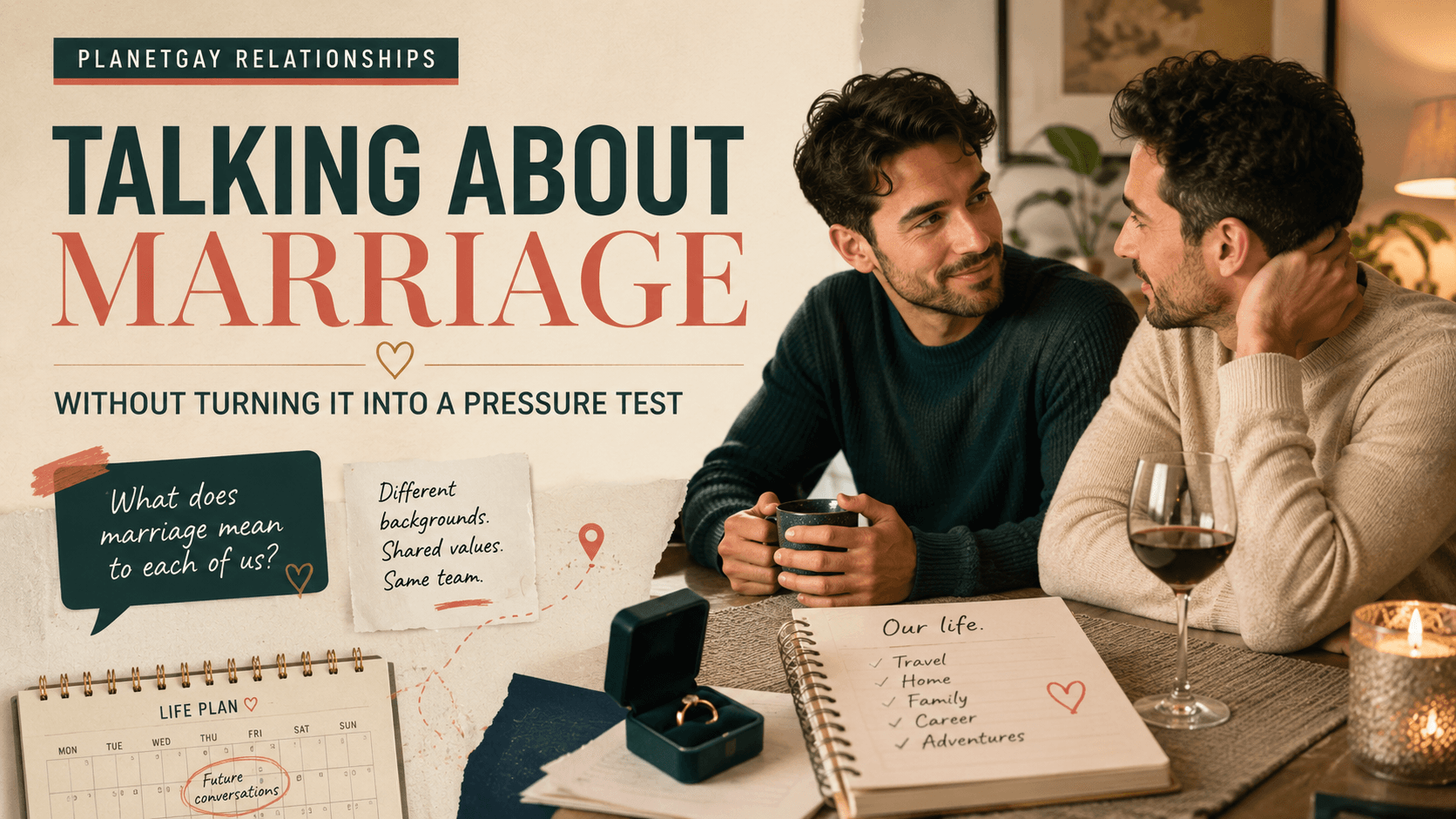
Starting from the underlying question — what kind of commitment do we each want, and on what timeline — is more productive than leading with 'do you want to get married?' The latter can feel like a test with a right and wrong answer. The former is a genuine conversation about compatibility and future planning.
Specific things worth understanding from a partner before the marriage question becomes urgent: does this person want a long-term committed relationship with me? Do we have compatible ideas about what commitment looks like — exclusive or not, in the same home, with shared finances, etc.? Does legal recognition of the relationship matter to them, and if so why? Is there a timeline on which they are thinking?
Handling different timelines
One of the most common points of tension around marriage discussions is timing. One partner is ready earlier than the other. This mismatch can become a recurring source of pressure if it isn't handled directly.
The most useful approach is to be clear about your own position without making it an ultimatum, and to understand your partner's position without treating their difference in timeline as rejection. 'I'm not ready yet' means something very different depending on whether it means 'not for another six months' or 'I don't know if I ever will be' or 'not until some specific conditions are met.' Knowing which of these is the real answer is important.
For the partner who wants commitment sooner: it is reasonable to share that the current timeline is difficult for you, and to ask for clarity on your partner's timeline. What is not constructive is treating a difference in readiness as evidence that your partner doesn't love you, or creating repeated pressure situations that make the topic dread-inducing.
For the partner who is less ready: being clear about why — and being honest if the 'not yet' is genuinely 'not sure if I want this at all' — is more respectful than allowing your partner to operate on an assumed timeline that you haven't confirmed.
Family and cultural complexity
For gay couples whose families are not fully accepting, marriage adds a complication: the question of who is included in what is supposed to be a celebration. Planning a wedding or ceremony when one or both partners' families are not supportive or are estranged involves navigating difficult feelings about recognition and grief alongside the practicalities of an event.
For couples where families are from different cultural backgrounds, or where one partner's family is in a country where same-sex marriage is not legally recognised, there may be additional layers about how the relationship is acknowledged by different families and communities.
None of these complications makes marriage impossible, but they do make the conversation more complex than the conventional narrative suggests. Discussing these in advance — rather than discovering them when the practical planning starts — reduces the emotional load.
Commitment without marriage
Marriage is one form of commitment. It is not the only form, and not every gay couple either wants it or has equal access to it — in some countries same-sex marriage is not legal, and in some jurisdictions civil partnerships are available but marriage is not.
Couples who are committed to each other without legal recognition of that commitment should be aware of the practical implications: in many jurisdictions, an unmarried partner has limited automatic legal rights in specific situations — medical decisions in emergencies, inheritance without a will, hospital visitation rights, and assets on separation. Getting specific legal advice on the implications of your arrangement, and taking appropriate legal steps (wills, power of attorney documents, property agreements) to protect both partners, is practical rather than pessimistic.
For many couples, an explicit commitment that is not a legal marriage is the right arrangement. For others, the legal protections and social recognition of marriage are important. Both are valid positions; what matters is that both partners are actually on the same page about which.