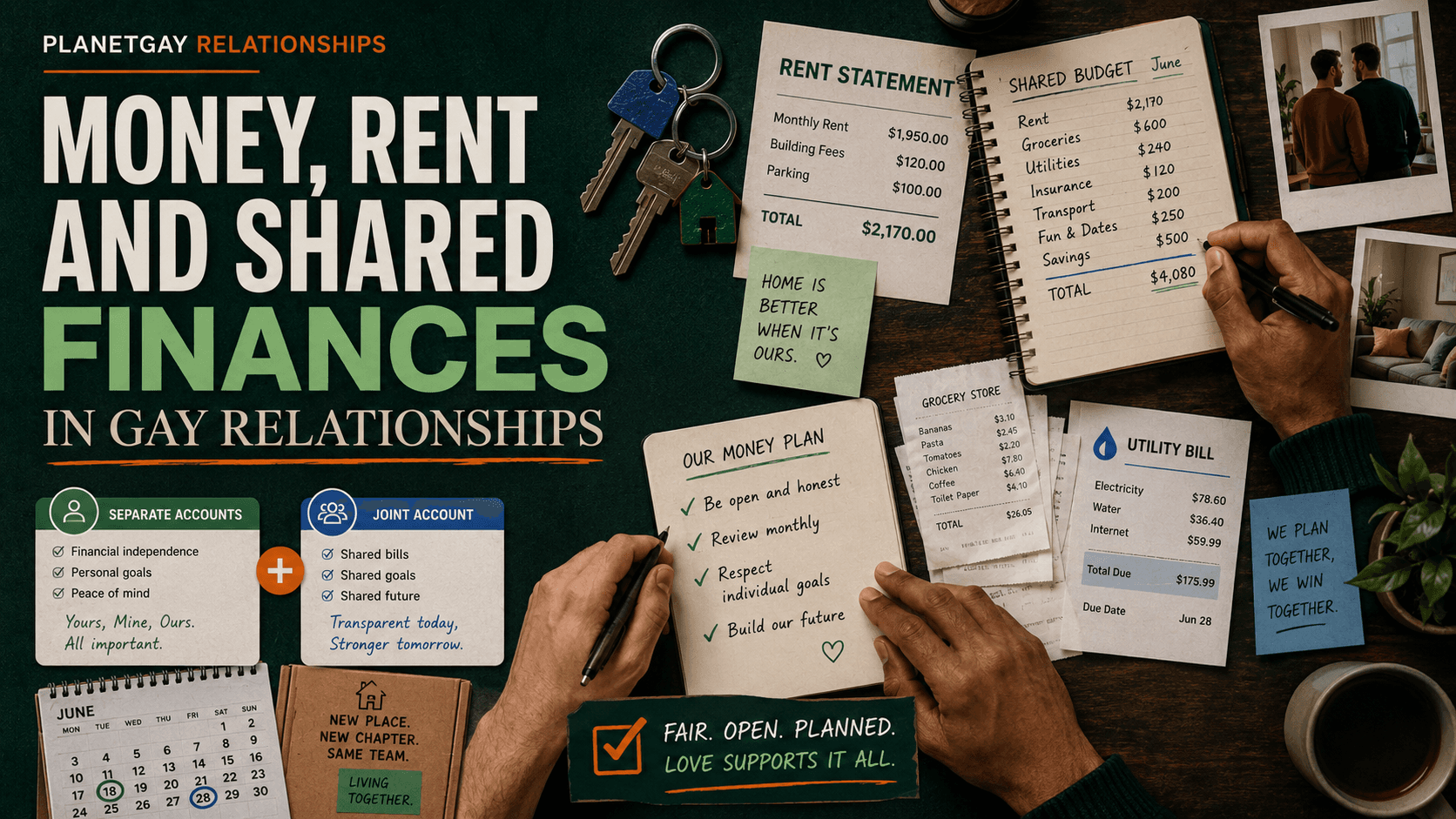
Why money is worth talking about early
Financial incompatibility is one of the most reliable predictors of relationship breakdown across all types of relationship. The conversation about money — how each person relates to it, what they earn, how they like to manage it — tends to be delayed well past the point where it would be most useful. By the time financial stress arrives, positions have often already hardened.
For gay couples, this conversation sometimes has an additional complication: many gay men grew up without a relationship model that mapped clearly onto their own situation. The conventional heterosexual default — one person earns more, conventional roles about who pays for what — does not automatically apply. This can actually be useful, because it creates an opening to design financial arrangements that actually suit both people rather than defaulting to assumptions that may not fit.
Before moving in together
The decision to move in together brings financial questions that are worth making explicit before the lease is signed. What does each person earn? This does not need to be an exact figure if one or both partners are uncomfortable with full disclosure, but a general understanding of the gap between two incomes (or whether it's broadly similar) affects everything from what kind of place you can afford together to how rent is split.
Rent proportional to income versus rent split equally are the two most common approaches, and neither is automatically right. A 50/50 split feels superficially fair but leaves one person in a much tighter position if incomes differ significantly. A proportional split feels more equitable but requires ongoing disclosure about income and requires renegotiation when incomes change.
A third approach that some couples use: one person covers a specific regular cost (e.g., rent) and the other covers a different one (utilities, groceries), with the allocation designed to be roughly equivalent. This avoids pooling money entirely while distributing responsibility.
Legal context matters: in jurisdictions that recognise cohabitation rights, moving in together may have legal implications even for unmarried couples. In others, cohabitation has no automatic legal standing. Knowing which applies to your situation before moving in is worth doing. Your local citizens advice or equivalent can advise on cohabitation rights in your jurisdiction.
Joint accounts: a practical framework
Joint bank accounts are a tool with specific advantages and disadvantages. The advantages: simplicity for shared expenses, transparency about household finances, ease of payment for shared costs. The disadvantages: full visibility of each other's spending, potential complications if the relationship ends, and the requirement for mutual trust and similar financial styles.
A common middle-ground approach is a joint account specifically for household expenses — rent, utilities, food, shared subscriptions — into which each partner contributes a fixed amount each month, while maintaining separate accounts for personal spending. This creates transparency about shared costs without requiring full financial merger.
For same-sex couples who are legally married or civilly partnered, joint accounts also interact with inheritance, tax and asset-division rules in specific ways. A financial adviser who understands the legal framework in your jurisdiction can advise on the implications. The legal landscape for same-sex couples' financial rights varies by country and has changed in many places in recent decades — current professional advice is worth seeking rather than relying on older information.
Big financial decisions
Joint purchases — particularly property — are where financial incompatibility and communication failures have the largest consequences. Buying property together creates a legal and financial relationship that persists whether or not the personal relationship does. Before purchasing property together, it is worth having explicit conversations about what happens if the relationship ends: who buys the other out, on what basis the value is assessed, whether either person could afford to remain in the property alone.
This is not pessimism about the relationship; it is the same planning that any significant financial commitment warrants. People who do this planning are not more likely to separate; they are better positioned to handle it if they do, and the clarity of the conversation often reinforces rather than undermines trust.
For same-sex couples who are not legally partnered or married, legal protections around property acquired during a relationship vary significantly by jurisdiction. In many places, assets go to the legal owner in a separation, with no automatic right for the non-owning partner. A solicitor or lawyer who is familiar with your jurisdiction and LGBTQ+ legal context can advise on how to structure shared property purchase to protect both partners.
Income differences and power dynamics
Significant income differences between partners can create power dynamics that interact with money in uncomfortable ways. The higher-earning partner paying for most shared experiences may feel like generosity; over time it can also feel like control, or like the lower-earning partner is dependent. These dynamics are not exclusive to gay relationships, but they can combine with other dynamics — age differences, experience differences, out-and-not-out situations — in specific ways.
The most useful approach is explicit conversation about what each person is comfortable with, rather than allowing arrangements to drift into positions that aren't working. What is the higher-earning partner comfortable subsidising, and what feels like a burden? What does the lower-earning partner need to feel financially autonomous and not dependent? These conversations are uncomfortable and necessary.
Financial autonomy within a relationship
Maintaining individual financial autonomy within a relationship — having money that is yours and that you control — is important for most people and particularly important in contexts where the relationship ends and you need to rebuild. This is not about distrust; it is about recognising that financial dependence on a partner creates vulnerability.
This applies with particular force for gay men who have faced family rejection or whose family has not supported them financially in the way that the relationship partner may have. Financial dependence within a relationship should be actively managed — through income, savings and financial planning — rather than normalised.