Understanding what discrimination is
Discrimination based on sexual orientation means being treated less favourably in a relevant context because of your sexual orientation. Legal definitions vary by country and context — not all unfair treatment is legally actionable, and not all legally actionable treatment is reported or prosecuted. This article is about practical response to discrimination in everyday life, not a substitute for legal advice.
Some of what LGBTQ+ people experience is clearly discriminatory: being refused service, terminated from employment, denied housing, harassed in a public space or subjected to a hate crime. Some is harder to identify: a hostile professional environment that never quite crosses a legal threshold, differential treatment that may or may not reflect explicit bias, patterns that are only clear over time rather than in a single incident. This guide covers responses across the range.
In the moment: prioritising safety
In a situation involving verbal harassment, threatening behaviour or physical danger, your immediate safety takes priority over documentation or confrontation.
Steps that are generally useful:
**Do not engage with someone who is aggressive or threatening.** Confrontation rarely improves a threatening situation and can escalate it. Moving away from the person and toward a more public or populated space is usually the better choice.
**Contact emergency services if there is immediate danger.** Emergency numbers vary by country: 999 in the UK, 911 in North America, 112 in most of Europe.
**If safe to do so, note details.** Time, location, what happened, the appearance of anyone involved. This is useful if you decide to report.
**Ask for help if available.** Staff in public settings (shops, transport, venues) have responsibilities around customer safety and can often assist by removing the person from the situation or contacting security.
Documenting incidents
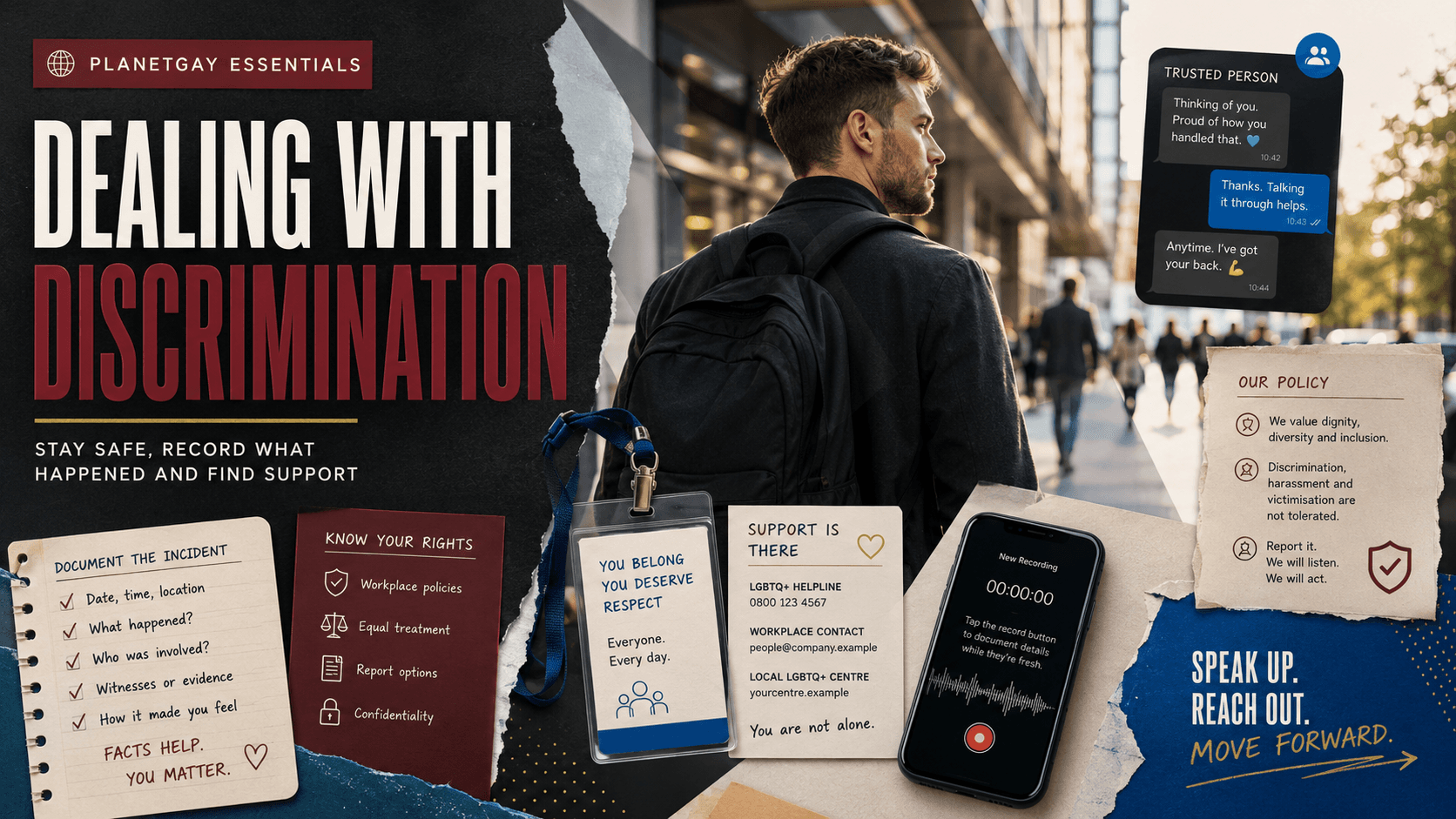
Documentation is important if you want to report an incident or pursue any formal response. Useful documentation includes:
**A contemporaneous note** of what happened, when, where, who was involved and who witnessed it. Write this as soon as possible after the incident, while details are fresh.
**Photographs or screenshots** if the discrimination occurred in writing, online, in signage or in any form that can be captured.
**Communications records** — emails, texts, written notices — if the discrimination involved written communication.
**Witness details** if anyone else saw what happened and would be willing to confirm their account.
Good documentation does not guarantee a successful formal complaint, but its absence significantly limits your options.
Reporting options
Reporting options vary by type of discrimination and by country:
**Hate crimes:** Report to the police. In the UK, you can also report to Galop (galop.org.uk), the LGBTQ+ anti-violence charity, which provides independent support and can help with the reporting process. In the US, the FBI accepts hate crime reports at tips.fbi.gov.
**Discrimination in employment:** Employment discrimination based on sexual orientation is illegal in many countries. In the UK, the Equality Act 2010 covers employment discrimination; complaints are handled through Employment Tribunals. In the US, the EEOC handles employment discrimination complaints. In Canada, human rights tribunals handle these at federal and provincial level.
**Discrimination in services:** In the UK, the Equality Act covers discrimination in the provision of services. Complaints can be made to the Equality and Human Rights Commission. Other countries have equivalent bodies.
**Not all discrimination is legally actionable** in all jurisdictions. An equality organisation or legal advice service can advise on whether a specific incident meets the threshold in your context.
Getting support
Experiencing discrimination is stressful and often distressing. Support is available through:
**Galop (UK):** Specialist LGBTQ+ anti-violence organisation, providing advice and support for people who have experienced hate crime or discrimination.
**Stonewall:** Information on rights and reporting, with links to specialist legal support.
**The Equality Advisory and Support Service (UK):** Government-funded service providing advice on the Equality Act and discrimination complaints.
**Citizens Advice (UK):** Free advice on legal rights and the complaints process for various discrimination contexts.
**GLAAD and Lambda Legal (US):** Information on LGBTQ+ legal rights and discrimination.
For the emotional impact of discrimination: LGBTQ+-affirming mental health services can help process the experience. Discrimination has documented mental health effects, and the response — anger, anxiety, a reduced sense of safety — is a normal reaction to an abnormal treatment, not a personal failing.
Legal protections vary — an honest note
This article does not provide legal advice. Legal protections against LGBTQ+ discrimination vary significantly by country, by the type of discrimination (employment, housing, services, public life), and by how laws are enforced in practice.
Before deciding how to respond to a specific discrimination incident in a formal way, it is worth seeking advice from an equality organisation or legal advice service in your jurisdiction about what protections apply and what realistic options exist. Acting on incorrect assumptions about what the law covers can result in significant unexpected costs or outcomes.
In countries where LGBTQ+ discrimination is not covered by law, formal reporting may not be possible and may carry risks. In those contexts, community organisations can often advise on safer approaches to addressing discrimination.