Why preparation matters more than most guides admit
Most travel problems that LGBTQ+ travellers encounter — legal risk, inadequate insurance cover, accommodation incidents, medication confiscation — were theoretically addressable before departure. The practical reason they weren't addressed is usually that the research was uncomfortable or time-consuming, and the assumption was that things would probably be fine.
For most destinations and most trips, things probably will be fine. For some destinations, the margin is narrower than a casual assumption allows. And even for generally safe destinations, some categories of preparation (insurance cover for your specific situation, medications with adequate supply, emergency contact information) are simply good practice regardless.
This checklist is structured as a pre-booking review: things to check before you confirm a booking, not just before you leave.
Legal safety: before you book
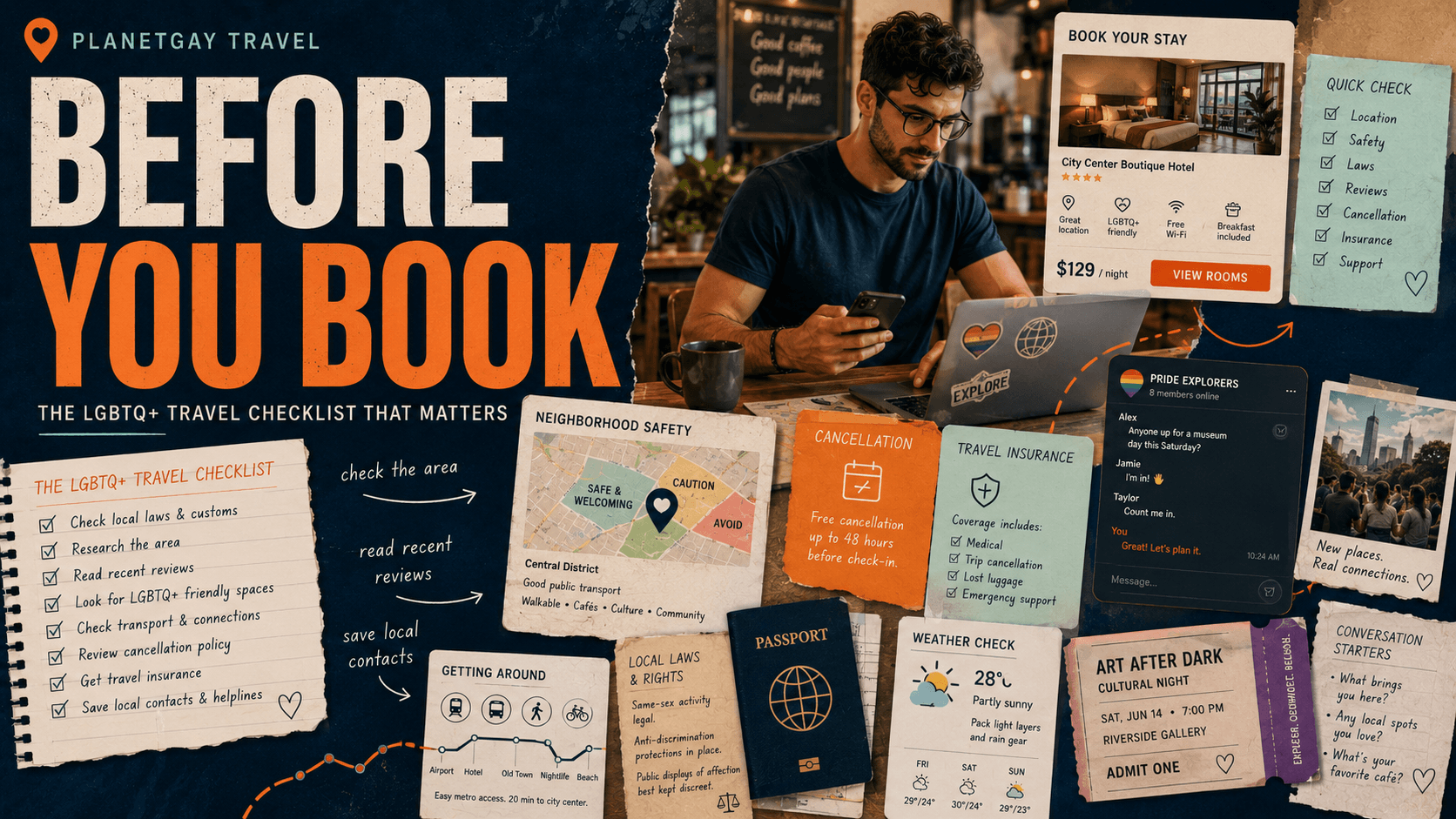
**Check the legal status of same-sex relationships.** ILGA World (ilga.org) maintains the most current global map of sexual orientation laws. For any destination, know: is same-sex activity criminalised? What are the penalties? Are there enforcement patterns relevant to tourists?
**Check current government travel advice.** The UK FCDO (gov.uk/foreign-travel-advice) and US State Department (travel.state.gov) both maintain country-specific travel advice pages including LGBTQ+-specific sections. Check these for the current official assessment, particularly noting whether advice has changed recently.
**Consider what you'll carry.** In countries where same-sex relations are criminalised or heavily stigmatised, having visibly gay content on your phone — apps, photos, messages — can create risk if your device is inspected. Consider this before travelling to higher-risk destinations.
Travel insurance
**Verify that your policy covers your specific situation.** Some travel insurance policies have exclusions or limitations relevant to LGBTQ+ travellers. Check: - Whether your policy covers your same-sex partner under any relevant sections - Whether any health-related exclusions apply to medications or conditions that are specifically relevant to your health - Whether the policy provides medical cover that includes repatriation if needed
**PrEP and HIV medication specifically.** If you are on PrEP, HIV treatment, or other medications, your insurance cover for related medical needs — and your ability to travel with and access those medications — should be confirmed before booking.
**If the destination has significant risk.** For destinations with elevated LGBTQ+ risk, check whether your policy will actually cover you if an incident arises from the local legal or social context.
Accommodation
**Choose accommodation explicitly confirmed as LGBTQ+-welcoming.** In destinations with any ambiguity, staying in accommodation that explicitly welcomes same-sex couples removes a significant source of potential difficulty. This may mean choosing an international chain, a property with explicit LGBTQ+ welcoming policy, or accommodation recommended by LGBTQ+ travel communities for the specific destination.
**Book in both names if sharing.** If booking accommodation as a couple, having both names on the booking removes the ambiguity of a same-sex couple arriving to a single-name reservation.
**Read reviews from LGBTQ+ travellers.** General rating scores don't reveal whether same-sex couples had comfortable experiences. Filtering for relevant recent reviews, or looking at LGBTQ+ travel community recommendations, provides more relevant information.
Medications and health
**Carry sufficient supply.** Do not assume you can obtain medications in destination. Take more than you need for the trip — pharmacy availability, the specific formulation, and the ability to obtain without a local prescription all vary.
**Understand customs rules.** Some countries restrict the import of medications that are freely available elsewhere. HIV medications and PrEP are specifically restricted in some countries. Check the embassy or consulate of your destination country for current rules.
**Carry prescriptions and documentation.** For any prescription medication, carry the original prescription or a letter from your GP confirming you are prescribed the medication. Keep it accessible, not in checked luggage.
**Health services at destination.** If you have specific health needs, establish in advance where relevant healthcare services are at your destination. LGBT Foundation (lgbt.foundation, UK) can advise on LGBTQ+-friendly healthcare in some destinations.
Emergency contacts and practical preparation
**Note emergency contacts for the destination.** These include: emergency services numbers (999/911/112 and local equivalents), local LGBTQ+ organisations that may provide support if needed, and your country's embassy or consulate details — accessible without requiring your phone if it is unavailable.
**Share your itinerary.** Leave a clear itinerary with someone you trust, including accommodation contacts. This is general travel safety practice that becomes more important in destinations with any elevated risk.
**Inform your bank.** Notifying your bank of travel dates prevents card blocks that can leave you without access to funds.
**Register with your embassy.** For higher-risk destinations, registering your trip with your government's travel registration system (FCDO's LOCATE service for UK citizens; Smart Traveler Enrollment Program for US citizens) means that if something goes wrong, your government knows you are in the country.