Why some men want to meet people differently
Dating apps are efficient in some ways and exhausting in others. The gesture required — snap judgment from a photograph — screens out things that matter in real relationships and amplifies things that don't. Some men find apps effective; others find that they feed anxiety, body comparison or compulsive checking in a way that stops being useful quickly.
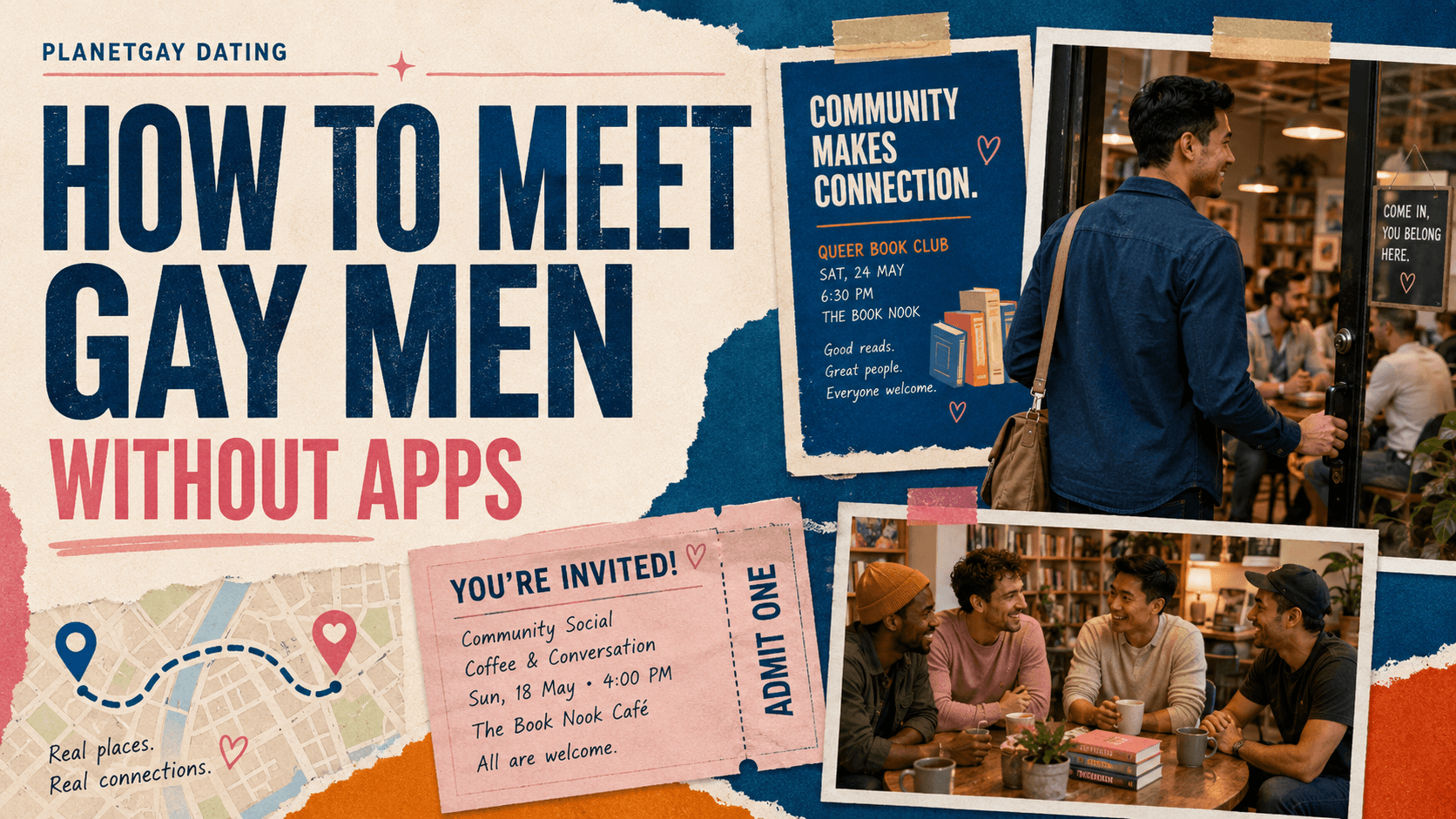
Offline approaches to meeting people take longer. They require repeated contact, which is how most attraction in real life actually develops. They also tend to produce a different kind of connection — one grounded in observed behaviour, shared experience and existing context, rather than curated self-presentation. Neither approach is objectively better; they suit different people and different situations.
Community spaces that are worth your time
LGBTQ+ community centres exist in many mid-to-large cities and run a range of activities — film screenings, discussion groups, sport, social events, volunteering programmes, peer support and classes. These are designed for exactly the kind of low-pressure community participation that can lead to meeting people naturally.
The 519 in Toronto, Switchboard in London, various local community centres across Europe and North America all function as examples. Most larger cities have at least one equivalent. If you are not sure what exists in your area, local LGBTQ+ organisations often maintain event listings, and platforms like Meetup or Facebook Groups sometimes host LGBTQ+-specific social events that are not primarily dating-focused.
Church and Wellesley in Toronto, Soho in London, Schöneberg in Berlin and Chueca in Madrid are examples of neighbourhoods with concentrated LGBTQ+ community life — not just bars, but organisations, cafes, bookshops and social spaces that create the kind of repeated contact that builds familiarity.
Sport and physical activity
LGBTQ+ sports organisations exist in many sports: running clubs, football, hockey, volleyball, swimming, cycling, tennis, martial arts, yoga, hiking. The Gay and Lesbian Tennis Alliance, the International Gay Rugby association, and local LGBT sports leagues in cities across the UK, Canada, the US, Germany and Spain are examples.
Sporting contexts create regular contact, a shared structure and a natural way to interact with people repeatedly over time without it being socially charged. If you join a running group and show up each week, you will have many short conversations with the same people before anyone has to manage the pressure of a formal date. That familiarity tends to make attraction more grounded.
Many of these organisations are explicitly open to allies and LGBTQ+ people across the spectrum — you do not need to be gay, or fully out, to participate.
Volunteering and civic life
LGBTQ+ charities, hospices, community organisations, Pride committees, health clinics, helplines and advocacy groups all need volunteers. Contributing time to these organisations puts you in a room with people who share a values orientation, creates natural conversation and demonstrates something real about your character — which is more than a dating profile manages.
Beyond LGBTQ+-specific organisations, volunteering in general — in food banks, community gardens, environmental groups, libraries, festivals, arts organisations — creates the same kind of structured repeated contact. Many queer men participate in mainstream civic life without it being publicly labelled, and those spaces can be as productive for meeting people as explicitly queer ones.
Friendship networks as a starting point
Meeting someone through friends is still one of the most common routes to relationships. If you have LGBTQ+ friends, they likely know other queer men — some of whom might be people you would enjoy meeting. Saying directly to a friend 'I would be open to meeting someone if you have anyone in mind' is not desperate; it is honest. Most people are happy to make introductions if they think it might work.
If your current social network is small or largely outside LGBTQ+ spaces, this is harder — but it is not a fixed situation. Building a larger community of LGBTQ+ acquaintances through the routes described above tends to expand the network of people your friends might introduce you to over time.
Mixed social events — dinner parties, after-work drinks, birthday gatherings — that include a mix of gay and straight friends create a casual environment that doesn't carry the pressure of a formal date.
Classes, interests and learning
Any ongoing activity where you encounter the same people repeatedly works, in principle, as a context for meeting someone. Language classes, creative writing groups, photography workshops, cooking classes, book clubs, ceramics, choir — the specific content matters less than the regularity and the shared focus.
The shared activity is important. When two people are both paying attention to something outside themselves — a task, a text, a performance — conversation is easier and evaluation is lower-pressure. You interact as a person in the world, not as a profile optimised for attraction.
This approach requires patience, because the endpoint is a longer way off than it is on an app. But for people who find app dynamics depleting, the tradeoff is often worth it.
If your local options are limited
Not everyone has access to a city with a visible LGBTQ+ community centre, a local queer sports league, or a neighbourhood with concentrated community life. In smaller towns, rural areas and places where LGBTQ+ life is less visible or safe, offline options are more limited.
In those contexts, online community can still produce offline connection — when enough online relationship is built that meeting in person becomes feasible. Regional LGBTQ+ organisations sometimes host events that draw people from a wider area. Pride events in nearby larger cities are often accessible. And moving to a place with more community infrastructure is sometimes a practical consideration for people whose quality of life is significantly affected by social isolation.
If none of this is accessible right now, online connection — while maintaining reasonable safety and privacy precautions — remains a valid starting point.