Legal disclaimer
This article is general informational content only. It is not legal advice. Laws change; this guide cannot guarantee that any information it contains is current at the time of reading. Before travelling, verify legal status directly through official sources. The guide aims to help readers find authoritative information, not to summarise legal status for specific countries.
What laws matter for LGBTQ+ travellers
Several distinct categories of law are relevant for LGBTQ+ travellers. The most basic is whether same-sex activity is criminalised. As of the ILGA World State-Sponsored Homophobia report, same-sex activity between consenting adults is criminalised in a significant number of countries — the exact figure changes as laws are amended. A second category is whether there are active enforcement mechanisms — whether police or authorities are actively policing same-sex behaviour, and whether those measures target tourists as well as residents.
Beyond criminalisation, other legal factors include: whether public display of same-sex affection can result in charges of public indecency; whether there are laws on 'propaganda' or 'promotion' of non-heterosexual identities (as exist in some countries); whether crossing borders with certain documentation (such as a same-sex marriage certificate) could create complications; and whether local authorities have access to your digital devices or communications and whether those could expose you.
The most reliable sources for legal status
ILGA World's State-Sponsored Homophobia report and their online database (database.ilga.org) provide country-by-country legal analysis updated regularly. This is the standard reference used by rights organisations and journalists for legal status tracking globally.
Equaldex (equaldex.com) aggregates legal status data on a range of LGBTQ+-related issues — marriage equality, discrimination protections, adoption rights, military service and more — and allows country-by-country comparison.
Your own country's foreign ministry travel advisory typically includes LGBTQ+ travel notes for many destinations: the UK FCDO, the US State Department, the Government of Canada and equivalent agencies in Australia, New Zealand and most EU countries all publish this information.
All of these sources should be checked directly before travel, not from a cached version in a travel guide. Legal situations change, sometimes quickly, and a guide that was accurate last year may not reflect the current situation.
What legal status does and doesn't tell you
Legal status is necessary context but it does not provide a complete picture of safety for LGBTQ+ travellers. Several important gaps: the law as written may differ significantly from the law as enforced. A country may have decriminalised same-sex activity but have police who harass or extort LGBTQ+ people. A country may have formal legal protections but a dominant social culture of hostility that affects daily safety.
Conversely, a country may technically criminalise same-sex activity but have enforcement that is rarely or never applied to discreet same-sex activity between tourists. This does not make the law irrelevant — the legal risk exists and can be activated — but it is part of a fuller picture of practical risk.
Community sources — LGBTQ+ organisations operating in the country, recent travel reports from LGBTQ+ travellers, and reports from international human rights organisations — fill in the gap between legal status and lived experience.
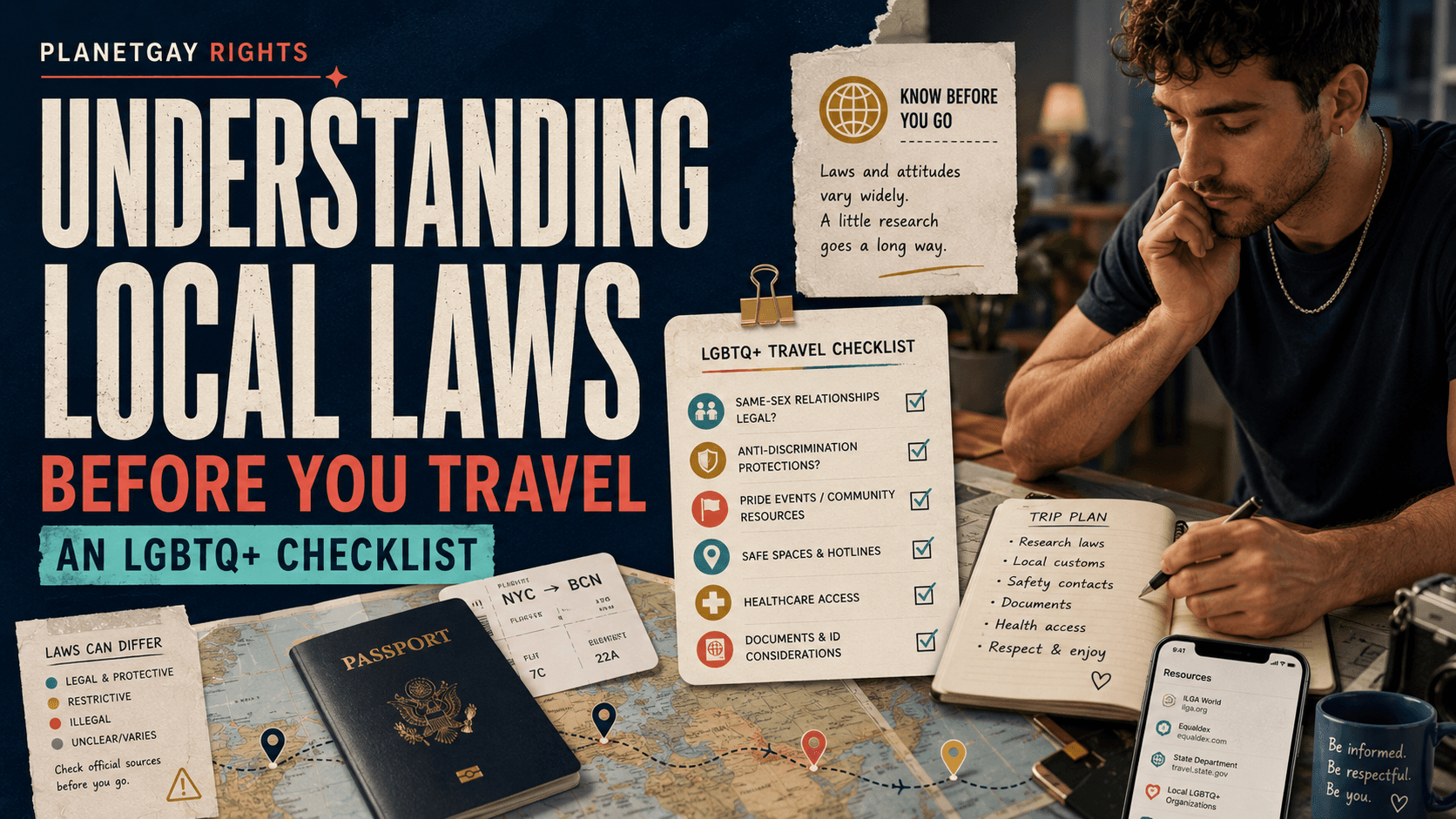
A pre-travel legal checklist
Before travelling, work through the following:
Legal status: Is same-sex activity between adults legal? Check the ILGA World database directly.
Enforcement: Is there current reporting of active enforcement or entrapment? Check recent reports from rights organisations and LGBTQ+ travel forums.
Public behaviour: Are there laws against same-sex public display of affection? Check your country's travel advisory.
Digital presence: Are there laws restricting LGBTQ+ content or communication online that could affect how you use apps or access websites?
Border issues: Could any documents (same-sex marriage certificate, medical records, medications associated with HIV treatment) create complications at immigration?
Consular support: Know the location and emergency contact details for your country's nearest embassy or consulate.
Refer to current official sources for all of the above. This list is a prompt, not an information source.
When you are not sure
If your research produces conflicting or uncertain information — sources that disagree on legal status, recent reports that suggest conditions have changed, or a destination where practical risk is hard to assess — treat the uncertainty as a reason for caution rather than reassurance.
For high-risk destinations, contacting LGBTQ+ organisations that work in or near that region can provide more current and locally specific information than any general guide. International human rights organisations including Amnesty International and Human Rights Watch publish reports on LGBTQ+ rights situations in many countries, which can supplement legal database information with current conditions.