Why accommodation choice matters
Where you stay significantly affects your experience as an LGBTQ+ traveller. In destinations where social attitudes toward LGBTQ+ people vary, staying at accommodation that is genuinely welcoming means you don't have to manage your identity at the front desk, in communal spaces, or in conversations with staff. That matters practically — your room, your security, your comfort — and emotionally, because the mental load of navigating potential hostility is real.
At the other end of the spectrum, in destinations with significant safety concerns, staying at accommodation that treats your LGBTQ+ status as non-information is a form of practical safety. Staff who know your sexuality and who are not discretion-oriented can expose you in ways that create risk in some contexts.
IGLTA-affiliated properties
The International Gay and Lesbian Travel Association (IGLTA, iglta.org) is a global trade association for LGBTQ+ tourism and travel. Members — which include hotels, tour operators, travel agents and destinations — commit to being welcoming to LGBTQ+ travellers and to non-discrimination in their services.
Searching for accommodation through the IGLTA network (iglta.org/find-travel-resources) provides a filtered list of hotels and accommodation providers that have explicitly committed to LGBTQ+ inclusivity. This is a more reliable signal than general 'gay-friendly' marketing, which can be vague.
IGLTA membership does not guarantee every staff member's personal attitude, but it does indicate a formal organisational commitment. In most destinations, an IGLTA-affiliated property is a safer accommodation choice than an unknown property.
How to assess a property online
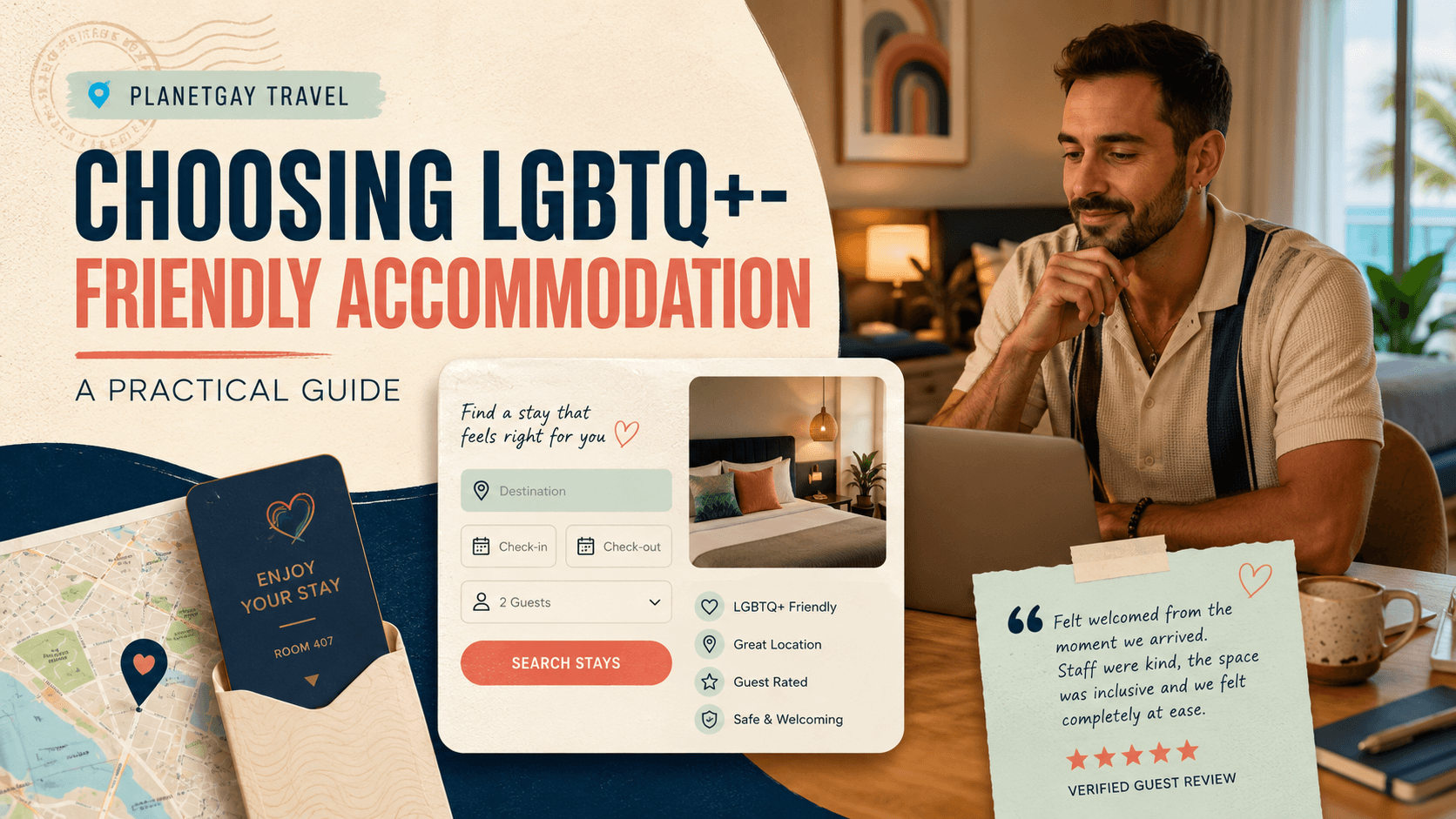
Before booking any property, several things are worth checking. Does the property explicitly market itself as LGBTQ+-friendly on its own website or in its booking descriptions? Properties that actively welcome LGBTQ+ guests are usually explicit about it rather than expecting guests to assume. Are there reviews from LGBTQ+ travellers on the booking platform or on travel sites? Specific review content — not just a star rating — is more informative about what the experience is actually like.
For destinations with higher safety concerns, it is also worth considering what the property's neighbourhood context is: a hotel in an area known for LGBTQ+ community life is likely to have a different environment than a similar property on the other side of the city. That said, avoid generalising about safety by neighbourhood — local conditions matter.
Privacy considerations in some destinations
In destinations where LGBTQ+ status could create legal or social risk, there is an additional layer of accommodation planning. At hotels in some countries, registration forms ask for relationship status or require documentation for unmarried couples sharing a room; in some places, unmarried couples of any gender are not permitted to share a room. For same-sex couples travelling in these contexts, researching specific accommodation policies before arrival can prevent an uncomfortable or unsafe check-in situation.
IGLTA-affiliated properties in conservative destinations typically have specific experience with LGBTQ+ guests and discretion in registration processes. In high-risk destinations, independent guest houses and hotels that operate outside major chain frameworks, and that have a visible LGBTQ+ clientele, are often recommended by community sources as safer options — though individual research is essential.
For the most current conditions, LGBTQ+ travel organisations and community resources for the specific destination provide more practical guidance than any general guide.
When to keep your identity private
In destinations with legal or social risk, discretion at accommodation is a practical safety measure. This might mean not openly discussing your relationship, not displaying obvious markers of LGBTQ+ identity in shared spaces, and being careful about who you trust with personal information.
This is not about shame. It is about risk management in specific contexts. Whether a particular level of discretion is warranted depends on the specific destination, the specific property, and your individual assessment of the risk involved — all of which require current local information to assess accurately.
A useful principle: in an unfamiliar destination, take your lead from LGBTQ+ community sources who are current about what is safe, not from assumptions based on how similar situations feel at home.