Medical disclaimer
This article contains general information about health topics relevant to ageing gay men. It is not medical advice. Specific health decisions should be made in consultation with a qualified healthcare provider. This article does not substitute for professional medical assessment.
A generation with a specific history
Gay men who are now in their 50s, 60s, 70s and older carry a specific historical experience that shapes their relationship to ageing. Many of this generation were young adults during the AIDS crisis of the 1980s and 1990s, when HIV was rapidly fatal and affected gay communities catastrophically. Many lost significant numbers of friends and partners; many survivors live with the lasting psychological impact of that period, including survivor guilt, complicated grief, and the effects of chronic stress.
They also came of age at a time when homosexuality was, in many countries, still illegal or recently decriminalised; when gay relationships had no legal recognition; when being openly gay was professionally and socially dangerous in ways that are meaningfully different from the present. The legal and social progress of the past two decades — marriage equality, anti-discrimination law, increasing public acceptance — has occurred within the lifetimes of men who are now in their 50s and older.
This history matters for understanding the specific context of ageing gay men, including patterns of isolation, specific health concerns, and the relationship to care systems that were historically not designed for them.
Community and isolation in later life
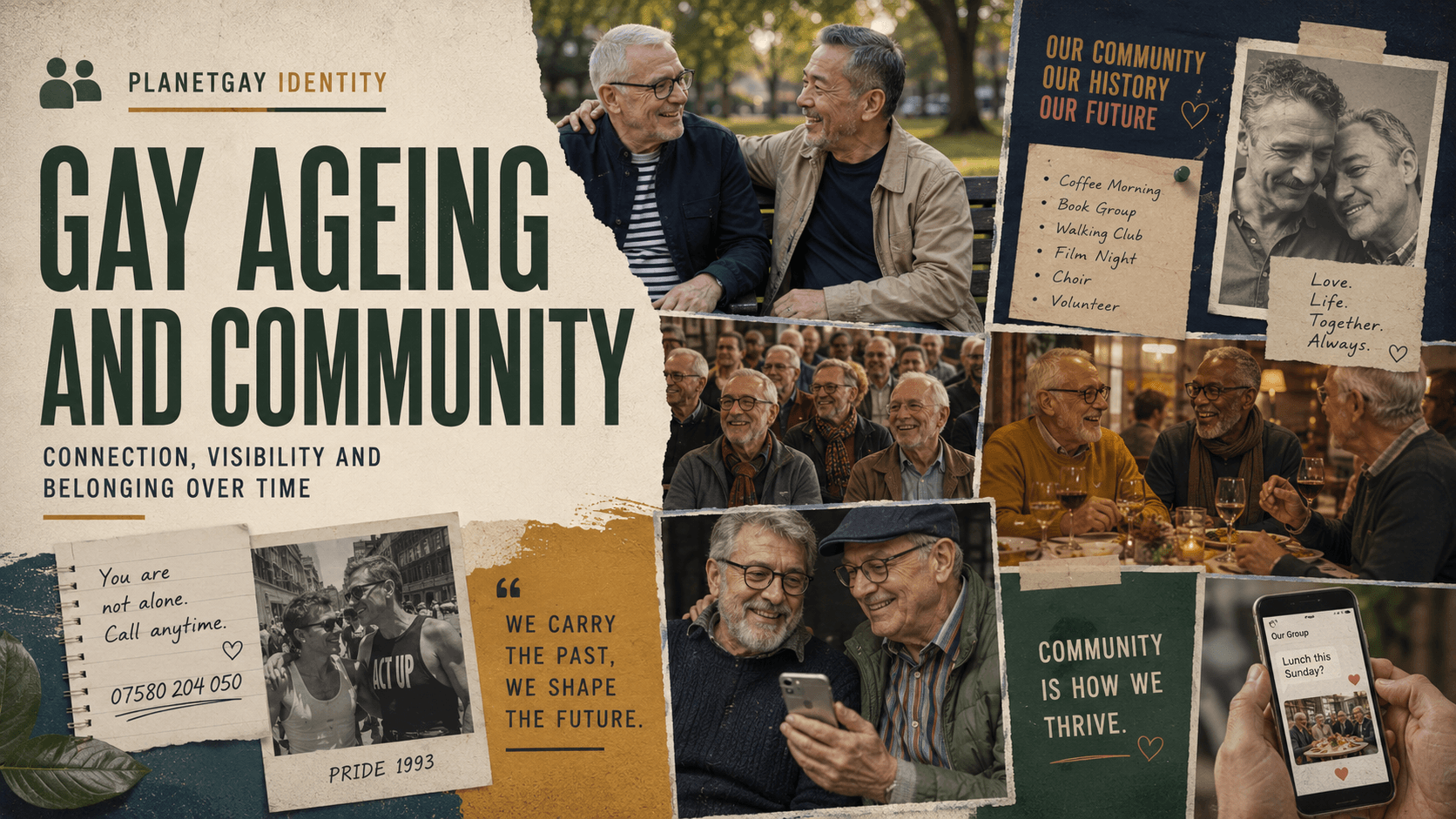
Loneliness and social isolation are significant health risks for older adults generally. For older gay men, specific factors can intensify these risks. Gay men are statistically less likely than straight peers to have children; their family networks may be smaller or more complicated by rejection histories. Partners may have died. Community connections from earlier life may have thinned as some peers left cities or died.
Research by Stonewall in the UK found that LGBTQ+ older people experience higher rates of isolation than their straight peers and are less likely to be 'out' to social care professionals — creating a specific barrier to accessing support in later life. The fear that care providers will not be accepting of their identity, or that care settings will be hostile, has been documented in research on older LGBTQ+ people's experience.
In many countries, LGBTQ+-specific services for older people are developing. In the UK, organisations including Age UK have produced guidance on LGBTQ+ inclusion in adult social care; LGBTQ+-friendly care homes and residential settings exist but remain limited. In the US, SAGE (Services and Advocacy for LGBTQ+ Elders, sageusa.org) is a national organisation specifically focused on LGBTQ+ older adults.
Health considerations
Gay and bisexual men face specific health considerations in ageing that are worth understanding and discussing with healthcare providers.
**HIV:** Gay and bisexual men who are living with HIV — many of whom have been on effective antiretroviral treatment for years or decades — face ageing-related health considerations that interact with long-term HIV and treatment effects. The cohort of people ageing with HIV is a new clinical reality; research is ongoing. If you are living with HIV, discussing ageing-specific health concerns with your HIV specialist is important.
**Mental health:** The cumulative effects of minority stress over decades — navigating discrimination, managing identity in hostile or partially-hostile contexts, experiencing the AIDS crisis — can have lasting mental health implications. Depression and anxiety rates among older gay men, while difficult to measure precisely, are believed to be higher than in straight peers. Access to LGBTQ+-affirming mental health support in later life is worth seeking proactively.
**Cancer screening:** Men who have had receptive anal sex have a higher risk of anal cancer; anal cancer screening (high-resolution anoscopy or anal Pap testing) is available in some sexual health clinics and should be discussed with a healthcare provider. This is not widely included in standard cancer screening protocols in all countries and may need to be specifically requested.
**Cardiovascular and metabolic health:** As for all men, cardiovascular health is a significant concern from midlife onward. Gay men who have used specific substances, including PrEP medications over long periods, may have specific considerations to discuss with their provider.
Visibility and representation
Older gay men are significantly underrepresented in media and cultural representation of gay life. The visual language of mainstream gay culture leans heavily toward youth; older gay men are less visible in gay media, less central to the conversations about gay identity and experience that dominate cultural spaces, and sometimes feel excluded from the gay community that was built partly through their own activism and survival.
This invisibility has practical effects: younger gay men may have limited models for what it means to age well as a gay man. Older gay men may feel disconnected from a community that appears oriented toward their juniors. The lived reality of ageing gay men — often richer, more connected and more settled than the cultural account suggests — is underreported.
Organisations including SAGE in the US, and smaller equivalents in other countries, work specifically on LGBTQ+ older adult visibility, care and community. These are worth knowing about as resources.
Planning for later life
Practical planning considerations that are specific or particularly relevant for gay men:
**Legal planning:** Without a biological family structure that automatically inherits or makes decisions, legal planning — wills, lasting power of attorney, advance care directives — is particularly important for gay men, including those who are partnered. Ensuring that your partner, chosen family or designated individuals have legal authority to make decisions on your behalf requires explicit legal documentation in most jurisdictions.
**Care and social care:** When considering care needs in later life, researching LGBTQ+-inclusive care options in advance — while you have full capacity to make decisions — is valuable. In many areas, LGBTQ+-welcoming care homes and community care providers exist; finding them is easier before you need them urgently.
**Community investment:** The community connections you build earlier in life tend to sustain you in later life. Investment in community — friendships, organisations, shared activities — in your 40s and 50s pays dividends in later decades.