Medical disclaimer
This article provides general information about alcohol use and wellbeing. It is not medical advice. If you are concerned about your relationship with alcohol or other substances, speak to a healthcare provider. If you are experiencing a medical emergency, call 999 (UK), 911 (US/Canada), or your local emergency number.
Why gay nightlife and alcohol are connected
Gay bars and nightlife venues have historically been among the few spaces where gay men could socialise, express themselves and meet others without the social pressure of the broader world. The community function of these spaces is real and historically significant. The association between these spaces and alcohol is not coincidental — the structure of bars and nightclubs places alcohol at the centre of the social experience.
Research consistently finds that gay and bisexual men have higher rates of hazardous alcohol use than their straight male peers. This is not because gay men are inherently more prone to drinking — it is because the structural and psychological factors at play (nightlife as primary community space, minority stress, social anxiety in unfamiliar spaces, the cultural normalisation of alcohol in gay social contexts) create conditions that support heavier drinking. Understanding this context is more useful than moralising about it.
Practical safer-use decisions
This section is not about not drinking. It is about making decisions that reduce harm while fully participating in social and nightlife culture.
**Know your own pattern.** If you regularly drink significantly more than you intend to, regularly can't remember parts of an evening, or find that nights out consistently produce negative consequences the next day — these are signals worth attending to, not judging yourself about.
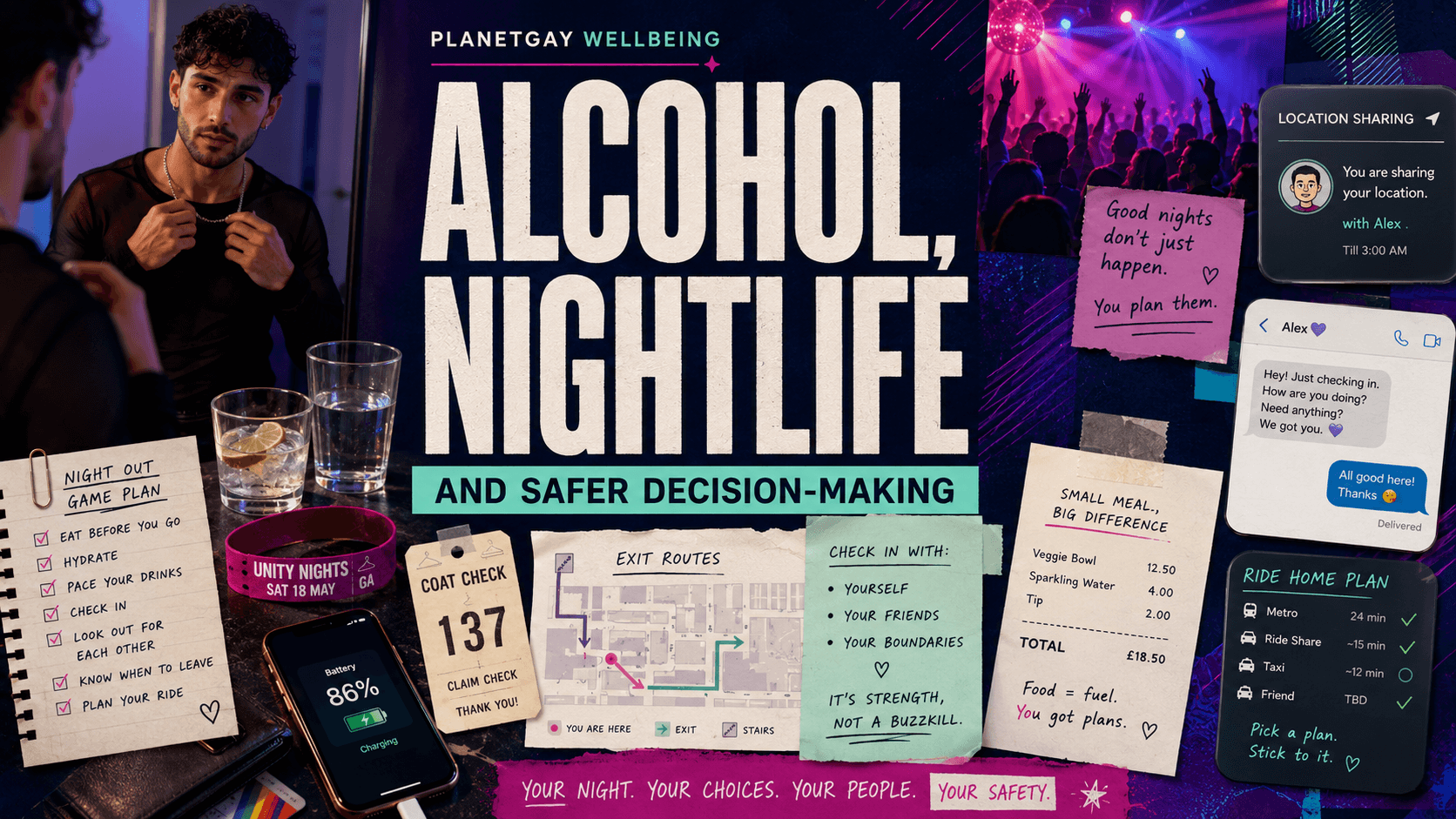
**Eat beforehand.** Basic harm reduction: drinking on an empty stomach accelerates intoxication. Eating before an evening out does not prevent the effects of alcohol but it changes the timeline and typically reduces the degree of intoxication at the same level of consumption.
**Pace yourself.** Social environments in nightlife create pressure to drink at the pace of the people around you. Choosing your own pace — including non-alcoholic drinks between alcoholic ones — is both possible and increasingly socially unremarkable.
**Plan your way home before you go out.** The decision about how you are getting home is much better made before you are drunk than after. A pre-booked or pre-arranged way home reduces the chance of decisions made in an impaired state.
**Look out for people you are with.** Nightlife safety is collective — looking out for friends, knowing who is in your group, having a way to contact each other.
Sexual decision-making and alcohol
Alcohol affects judgement. This is both obvious and worth stating directly in a gay men's context because the intersection of alcohol and sexual decision-making is a specific point of harm for some men.
Decisions made while intoxicated — about condom use, about meeting strangers, about what you are and are not comfortable doing — may not be the decisions you would make sober. This is not a moral judgment; it is a practical reality. Thinking in advance about the decisions you want to make — what you are comfortable doing without a condom, what you would need before meeting someone from an app — gives you a pre-determined position to return to even when your judgment is impaired.
For men who regularly find that alcohol leads to sexual decisions they are uncomfortable with in retrospect, this pattern is worth examining — not as a moral failing but as a practical safety issue that has solutions.
When patterns become a concern
There is a difference between recreational drinking that is within a manageable range and patterns that are causing consistent harm. Signs worth taking seriously: drinking significantly more than intended on a regular basis; drinking to manage anxiety or to be able to socialise at all; consequences from drinking (health, relationships, work, financial) that are recurring; trying to reduce drinking and finding it very difficult.
These are not signs of moral failure — they are signs of a pattern that has become harder to manage than recreational drinking. Talking to a GP, a mental health professional, or a support service is a reasonable response.
For gay and bisexual men specifically, there are support services that understand the specific context: Antidote at the LGBT Foundation (antidote.lgbtfoundation.org.uk) in the UK provides substance use support specifically for LGBTQ+ people. In North America, many LGBTQ+ community health centres have substance use support programmes.