What chosen family means
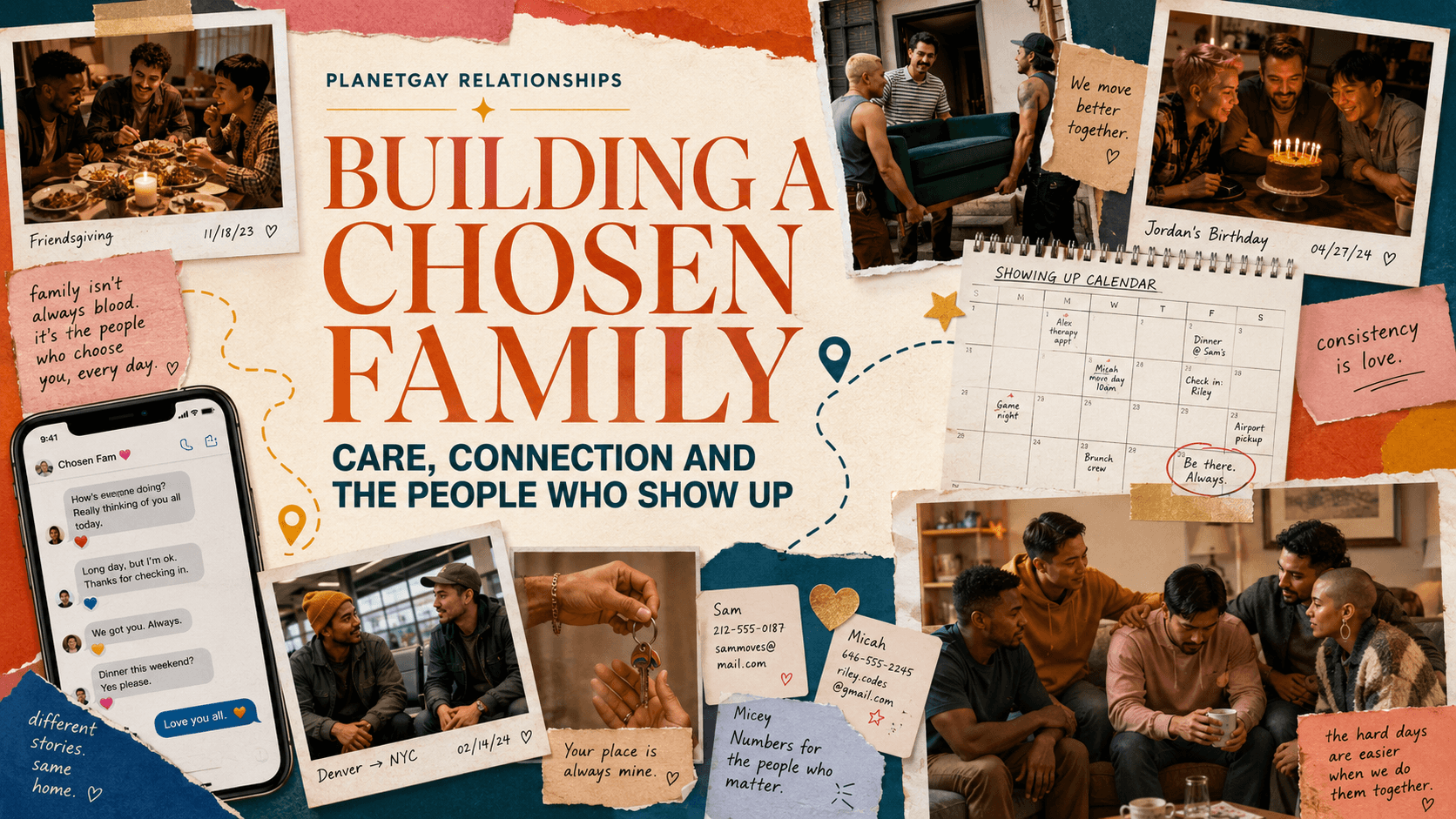
Chosen family — the people you have selected to fill the functions that biological family may not — is a concept that has been central to LGBTQ+ community life for decades. The phrase appears in the research literature, in community organisation language and in the everyday speech of LGBTQ+ people across generations.
It emerged partly out of necessity. Many gay and queer people, particularly in earlier decades, were estranged from biological family — through rejection after coming out, through family members who refused to accept their identity, or through the impossibility of being themselves in the family context they were born into. In this situation, the community structures that existed — found in bars, in circles of friends, in advocacy groups, in the ballroom scene — provided the reciprocal care and support that family is supposed to provide.
The concept is not limited to people who have been rejected by family. Many gay men maintain good relationships with biological family while also building chosen family — because their biological family, even if accepting, does not understand the full texture of their experience in the way that people who share it can.
Why it matters for gay men specifically
The Trevor Project's research into LGBTQ+ youth consistently identifies family acceptance as one of the most significant protective factors for mental health. The inverse is also documented: family rejection increases risk across multiple mental health outcomes. For gay men who have experienced family rejection, the question of where the care and belonging functions of family come from is not abstract — it is a practical question about survival and wellbeing.
Even for men whose families are accepting, there is often a gap. Biological family members who love their son or brother but who find his gay identity confusing, irrelevant or uncomfortable create a specific kind of partial acceptance — enough for the relationship to persist, but not enough for the full experience to be shared. The experience of being gay — the specific humour, the cultural references, the understanding of what specific situations feel like — is better understood within communities that share it.
Chosen family fills these gaps. It is the people who know exactly what you mean when you say something that your biological family would have to have explained to them.
How chosen families form
Chosen families form through sustained contact, mutual care and the gradual deepening of what begins as friendship. They are not announced — they are recognised over time as you look at the people in your life and see who has shown up consistently, who you turn to in difficulty, who you celebrate with, who has been present.
The practical implication is that chosen families are built through investment in specific relationships over time, not through seeking 'my people' as a category. The friend you have been meeting monthly for three years who happens to be the first person you called when something went wrong — that is chosen family in the making, or already built.
Contexts where chosen families form: LGBTQ+ community organisations; long-term friendships; sustained relationship networks from previous phases of life; shared experience (of coming out, of health crisis, of specific community history); and deliberately maintained contact over time. The ballroom community's mother/father/children structure is a formal version of the same underlying human process.
Being a chosen family member, not just having one
Chosen family is a reciprocal relationship. It involves being as well as having: being the person who shows up for the friend who calls in a crisis, being the one who remembers and checks in, being present in the consistent low-drama way that makes a relationship feel safe to depend on.
This reciprocity is worth naming because chosen family is sometimes discussed as if it is something to acquire — to seek people who will provide support — rather than something to build together. The investment is bilateral. If you want to have people who will be your chosen family, you need to also be someone's chosen family, with the consistency and investment that entails.
What to do when you don't have it yet
For men who are newly out, who have recently moved, who are disconnected from community, or who are working through the aftermath of family rejection, chosen family may not yet exist. This is a painful gap, and it is worth being direct about: not having it is a problem worth addressing, not a personal failing.
The starting points are community: LGBTQ+ organisations, sports leagues, interest groups, volunteering — contexts that create repeated contact with people who might develop into something more significant over time. Peer support programmes and community health centres often provide structured group settings that can be starting points.
For men dealing with acute loneliness, professional support — a therapist, a counsellor, a crisis line — provides immediate connection while longer-term relationships are being built. This is not the same as chosen family, but it reduces isolation during the building period. The Switchboard helpline in the UK (0300 330 0630) can provide connection and referral. The Trevor Project in the US has resources for younger men.
When biological family and chosen family coexist
For men who have both biological family and chosen family — which is most gay men at some point in their lives — navigating the relationship between these two systems of support is sometimes complex. Biological family members may not understand chosen family; chosen family members may carry the history of periods when biological family was absent or harmful.
This doesn't require resolution. Different relationships serve different functions and provide different kinds of support. Being able to hold both without requiring them to be equivalent or to understand each other fully is a practical skill. The people who have been with you through the specific parts of your life that biological family couldn't reach are not replaceable by acceptance that arrived later, even if that later acceptance is welcome.