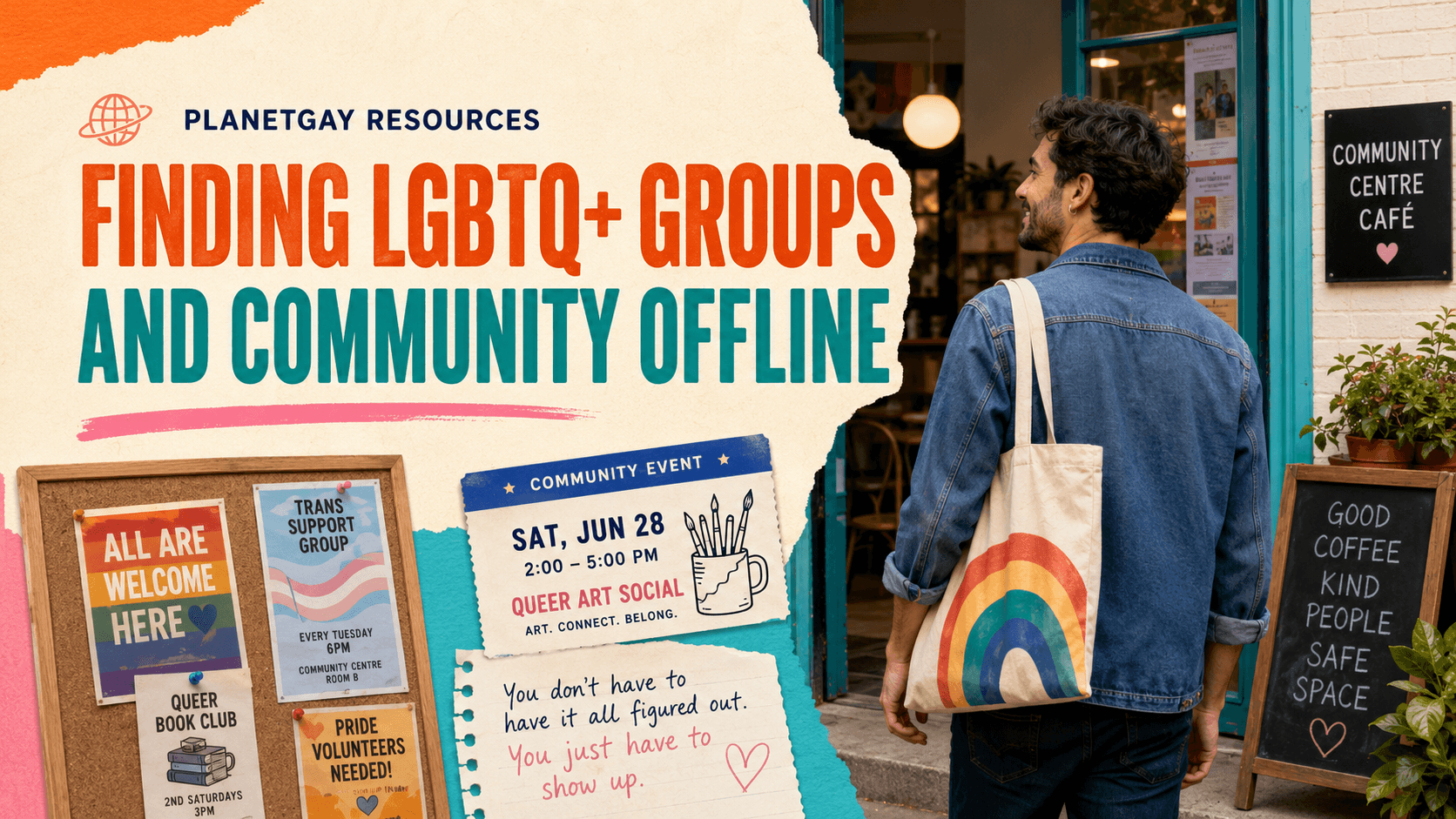
Why offline community is worth the effort
Online LGBTQ+ community is accessible, available everywhere, and easier to enter than in-person community. It is also — for most people — a partial substitute at best for in-person connection. The research on loneliness and wellbeing consistently finds that in-person relationships and community involvement provide benefits that online community does not fully replicate.
For gay men specifically, the research on minority stress — the cumulative psychological toll of navigating an environment that is not designed for you — suggests that community connection is one of the most significant protective factors. The 519 Community Centre in Toronto, Mind in the UK, and research from the Trevor Project all identify community as central to LGBTQ+ resilience and wellbeing.
Finding community offline takes more effort than scrolling through a forum, but tends to produce more durable connections and more of the wellbeing benefit that community is supposed to provide.
Starting with local LGBTQ+ organisations
In most cities with any significant population, LGBTQ+ community organisations exist. These range from major community centres (like the 519 in Toronto, or equivalent institutions in London, Manchester, New York and other cities) to smaller local groups, support organisations, youth services and social groups.
These organisations typically maintain knowledge of the local LGBTQ+ community landscape — what groups exist, what events are running, what resources are available. Contacting a local community centre or organisation is often the most efficient starting point for finding out what exists rather than trying to discover it independently.
If you are in the UK, Switchboard (switchboard.lgbt) operates an information service that can help identify local LGBTQ+ organisations and resources. In Canada, local community health centres in major cities typically have LGBTQ+ community referral services. In the US, the National LGBTQ Task Force (thetaskforce.org) and local LGBTQ+ centres can provide information.
For any country, the ILGA World directory of member organisations (ilga.org) provides a starting point for identifying national-level LGBTQ+ organisations that can refer to local resources.
Sports and fitness
LGBTQ+ sports organisations exist in most cities with active LGBTQ+ communities and provide one of the most reliable contexts for building regular in-person connection. The Gay Games and World OutGames movements have supported LGBTQ+ sports organisations globally; national and local affiliates exist in many countries.
Specific organisations to look for by sport: LGBTQ+ football leagues are affiliated with the IGLFA (International Gay & Lesbian Football Association, iglfa.org); running clubs in most major cities have LGBTQ+ options; swimming, cycling, volleyball, tennis, bowling, skiing, yoga — most sports have LGBTQ+-specific groups in cities with sufficient population.
If an LGBTQ+-specific sports group doesn't exist in your area for your preferred sport, general sports groups that are openly welcoming are a reasonable alternative. The regular contact structure is the valuable part — the LGBTQ+-specific framing makes it easier to enter but is not the entire value.
Privacy considerations
For men who are not fully out — particularly in smaller cities or communities where LGBTQ+ spaces and activities may not be fully private — attending LGBTQ+ community groups involves some exposure decisions. In a smaller city, attending a gay social group may mean encountering colleagues, neighbours or family connections in a context that reveals your identity.
This is worth thinking about before, not after: are you comfortable with the degree of visibility that attending a specific group involves? In a large city, the anonymity of urban life makes this less of a concern. In a smaller community, it is a real practical consideration.
For men in contexts where their safety could be affected by unwanted disclosure, online community and more private forms of connection may need to be the starting point while building toward more visible community involvement over time. Safety comes before community building.
What to do if nothing seems to exist locally
In areas without significant LGBTQ+ community infrastructure — smaller towns, rural areas, some conservative regions — the offline options may be limited. In this case:
Online community is a reasonable bridge: LGBTQ+-focused Discord servers, subreddits and interest communities provide connection while you are in a location with limited in-person options.
Travel to the nearest city with LGBTQ+ community infrastructure for occasional community events is worth considering for men for whom this is possible.
Friendships with LGBTQ+ people in other locations — maintained by messaging, video calls and occasional visits — provide connection that is not location-dependent.
For men in areas where physical safety or social context makes even private LGBTQ+ community contact risky, organisations like Stonewall and the Trevor Project can provide remote support and information.