The three host countries — an honest picture
The 2026 FIFA World Cup is hosted across three countries — the United States, Canada and Mexico — with 16 host cities split between them. All three countries have nationwide same-sex marriage. However, the experience for LGBTQ+ fans varies significantly depending on which host city you are travelling to, and this difference is worth understanding before you travel.
**United States:** Federal law does not provide comprehensive LGBTQ+ anti-discrimination protections (though the Supreme Court's 2020 Bostock decision extended Title VII protections in employment). State-level protections vary substantially. Host cities are spread across states with different legal and social environments for LGBTQ+ people — from Boston and New York (strong state protections and established LGBTQ+ communities) to Dallas-Fort Worth, Kansas City and Atlanta (states with more variable or limited LGBTQ+ protections).
**Canada:** Federal law provides strong LGBTQ+ protections. Canadian host cities (Toronto and Vancouver) both have established LGBTQ+ communities and strong city-level protections.
**Mexico:** Same-sex marriage is legally available across Mexico (through constitutional right, recognised in all states). Mexico City has strong local protections and an established LGBTQ+ community. Guadalajara and Monterrey have more conservative local cultures despite national law, and everyday LGBTQ+ experience varies.
US host cities — knowing the differences
The US host cities for the 2026 World Cup include: New York/New Jersey, Los Angeles, San Francisco Bay Area, Seattle, Boston, Dallas-Fort Worth, Atlanta, Kansas City, Houston, Philadelphia, and Miami.
For LGBTQ+ fans, the most relevant differences between US host cities are at the state level:
**States with strong LGBTQ+ anti-discrimination law:** California (LA, SF Bay Area), New York (New York/New Jersey), Massachusetts (Boston), Washington (Seattle). These states have comprehensive state-level protections.
**States with more limited protections:** Texas (Dallas, Houston), Georgia (Atlanta), Missouri (Kansas City). These states have less comprehensive or no state-level LGBTQ+ anti-discrimination law, though the host cities themselves may have city-level protections.
**Florida (Miami):** Florida has state-level legislation that has restricted some LGBTQ+ protections and expression in public contexts. LGBTQ+ fans travelling to Miami should review the current state of Florida law at time of travel.
This is not to say that Dallas, Atlanta or Houston are unsafe — they are not — but the legal framework and social context differ from cities in more protective states.
Practical fan safety planning
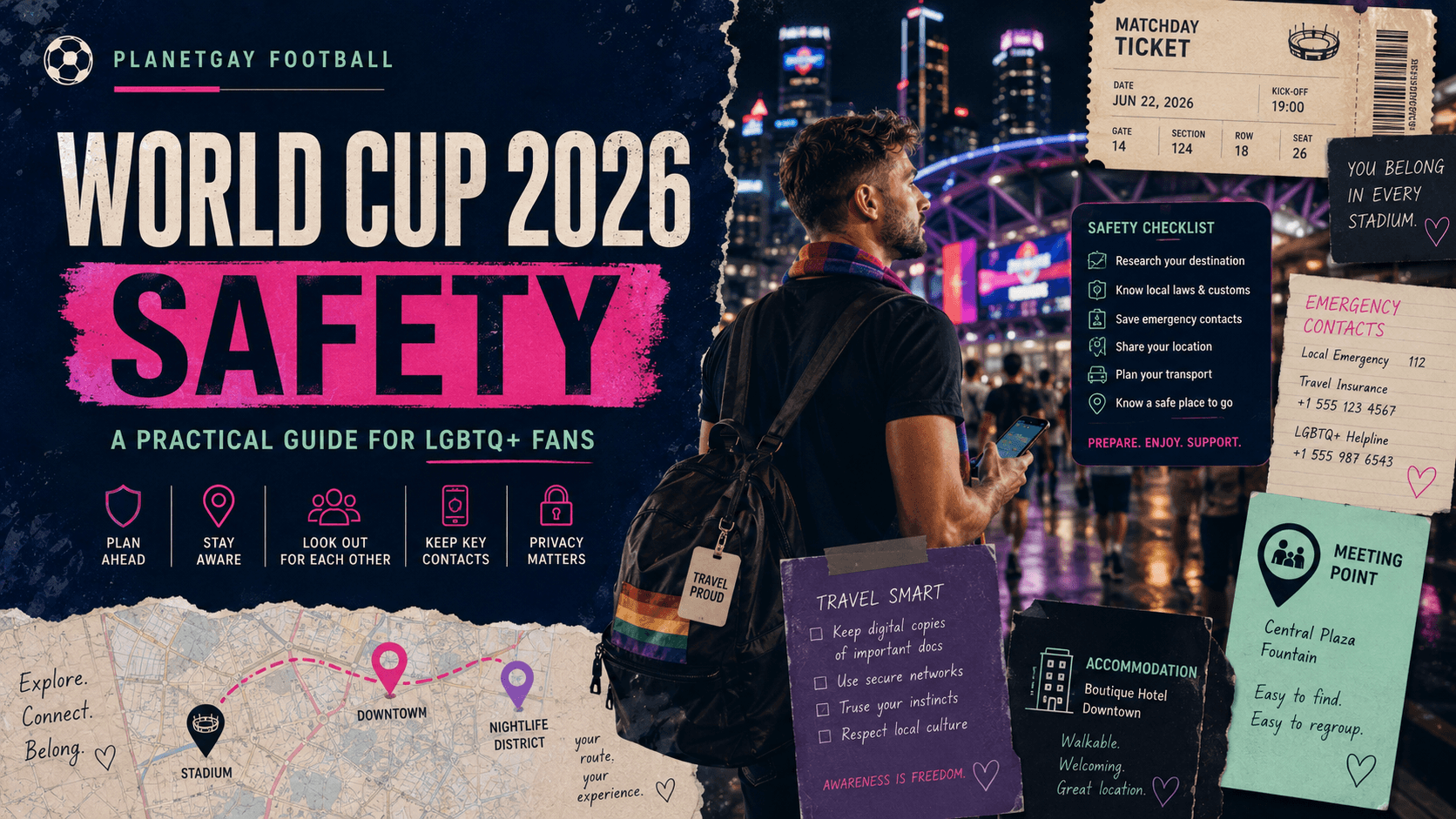
Regardless of host city, some consistent planning principles apply:
**Research your specific host city.** Before travelling to a US host city, check the current state of LGBTQ+ law in that state via the ILGA World database and your home government's travel advisory. City-specific LGBTQ+ organisations can provide current local context.
**Accommodation.** IGLTA member accommodation has committed to LGBTQ+ welcoming standards. Large international hotels in all host cities are generally safe environments. In cities with more conservative state environments, choosing IGLTA-affiliated accommodation or verified-LGBTQ+-friendly properties is a practical step.
**Fan zones and stadiums.** FIFA has human rights policies and anti-discrimination commitments that apply at tournament level. However, enforcement at individual venues and in fan zones is the responsibility of local authorities and will vary. Be aware that fan zone environments can be boisterous and that security staffing varies.
**Know your travel insurance.** Ensure your travel insurance covers you fully in the countries you are visiting. For US-based medical care, verify your cover before you travel — US healthcare costs for uninsured or under-insured visitors can be very high.
Mexico host cities
Mexico's World Cup host cities are Mexico City, Guadalajara and Monterrey.
**Mexico City** has a well-established LGBTQ+ community, strong local anti-discrimination law through COPRED (Consejo para Prevenir y Eliminar la Discriminación de la Ciudad de México), and a visible and active queer scene. The city's Zona Rosa neighbourhood is the main LGBTQ+ area. Mexico City is generally considered one of Latin America's most LGBTQ+-friendly cities.
**Guadalajara and Monterrey** are more socially conservative than Mexico City. Same-sex marriage is legal throughout Mexico, but social attitudes and the visibility of LGBTQ+ public life vary. LGBTQ+ fans should be aware that the experience in these cities may differ from Mexico City. Conservative social attitudes in some contexts may mean that higher-profile public affection between same-sex couples attracts unwanted attention in certain areas.
For safety in Mexico more broadly, check your home government's current travel advisory, which will include both general and LGBTQ+-specific notes for Mexico.
Tournament-level protections and limitations
FIFA's human rights policy (revised in 2017 and updated subsequently) includes non-discrimination commitments covering sexual orientation and gender identity. FIFA has worked with host organisations on LGBTQ+ inclusion commitments.
However, FIFA's commitments operate at the tournament level and do not override local law — in practice, they influence tournament operations and fan experience standards but do not create legal protections that supersede those of host cities and states.
The relevant comparison is with Qatar 2022, where significant concerns about host-country law created a difficult situation for LGBTQ+ fans. The 2026 situation is materially different — all three host countries have same-sex marriage and significantly better baseline protections. But the variation between host cities and states, particularly within the United States, is a real consideration.